
Adding one sentence to a reminder changes its entire neurological profile
In 2002, hospital hygiene researchers tried something simple. They put up signs near handwashing stations that said "Hand hygiene prevents you from catching diseases." Compliance among hospital staff improved marginally. Then they changed the signs to read "Hand hygiene prevents patients from catching diseases." Compliance improved by a factor of nearly three.
The task was identical. The physical act required was identical. The time cost was identical. The only thing that changed was the answer to the question: why does this matter right now, and to whom?
That single shift — from a self-focused reason to a patient-focused reason, from abstract hygiene protocol to immediate human consequence — was enough to dramatically change the behavior of trained medical professionals who already knew hand hygiene was important. They didn't need more information. They needed the right information, framed in a way that connected the action to what they actually cared about.
This is the "why this matters" effect. And it is one of the most reliable, most replicated, and most under-implemented findings in the behavioral science of follow-through.
The Implementation Intention Research
The foundational research on context and follow-through comes from Peter Gollwitzer's decades-long program of work on implementation intentions. The core finding is now well-established: people who form specific "if-then" plans — "When X happens, I will do Y" — are significantly more likely to follow through on their goals than people who simply form the goal intention itself.
Gollwitzer's original studies found that implementation intentions increased the likelihood of goal achievement by 200-300% across a range of contexts: cancer patients completing medical self-examinations, students completing assignments during vacation, people following through on resolutions to exercise. The effect has been replicated in dozens of subsequent studies across many different domains.
The mechanism is cognitive rather than motivational. An implementation intention doesn't necessarily make someone more motivated to pursue a goal — it creates a memory structure that links a situational cue to a specific response. When the situation occurs (the cue), the response is initiated more automatically, with less reliance on deliberate motivation in the moment. The decision-making burden is shifted from execution time to planning time.
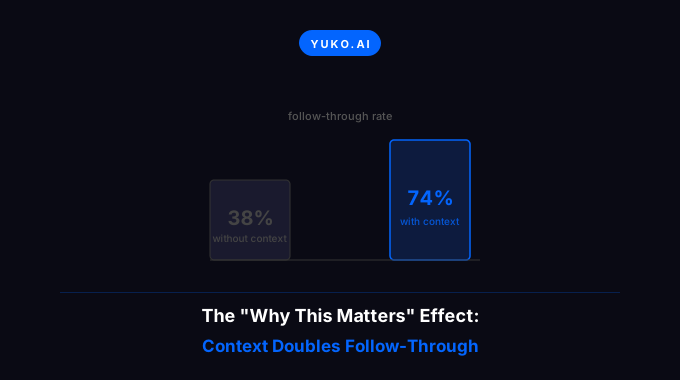
But there's a less-discussed finding in the implementation intention literature that matters enormously for reminder design: the specificity of the motivational context in the implementation intention predicts its effectiveness. An implementation intention that includes why the goal matters — "When I finish breakfast, I will go for a run, because I want to have energy for my family in the evenings" — outperforms one that specifies only the when-then structure. The motivational context isn't decoration. It's part of the activation mechanism.
How the Brain Processes "Why"
When a reminder arrives that contains only task information — "Call David" — the brain's processing is relatively shallow. The prefrontal cortex retrieves the associated task record, evaluates the effort required, compares it to current motivation level, and either initiates action or defers. In most cases, it defers. Motivation in the moment is almost always lower than motivation at planning time, and a task label without context provides nothing to counteract this decay.
When a reminder arrives that contains contextual information — "Call David — he's waiting to hear your decision before he can move forward on his project" — the processing is qualitatively different. The prefrontal cortex retrieves not just the task record but the relational and motivational context associated with it. The social consequence becomes vivid. The cost of deferral is represented concretely rather than abstractly. The anterior cingulate cortex generates a clearer mismatch signal between intention and current behavior.
In neuroscientific terms, the contextual reminder is recruiting the social cognition network — the brain systems involved in representing others' mental states — in addition to the task planning systems. Social cognition is not easily habituated; it remains sensitive to novel, person-specific information in a way that generic task labels are not.
This is why the hospital hand hygiene effect works. "Wash your hands" is a policy reminder that activates the habituated compliance pathway. "Wash your hands — your patient in Room 4 is immunocompromised" activates something more fundamental: the neurological systems evolved for tracking social obligation and consequence.
The Specificity Gradient
Not all contextual information is equally effective. The research on implementation intentions and motivational framing suggests a clear gradient from least to most effective:
A bare task label ("Exercise") is least effective. It provides no context, no reason, no situational hook.
A time-based task label ("Exercise at 7am") is slightly more effective because it creates a situational cue, but provides no motivational content.
A task with generic motivation ("Exercise — it's good for your health") adds a reason but one that is so habituated as to be nearly meaningless. Everyone knows exercise is healthy. That knowledge is not the barrier.
A task with personally relevant, emotionally specific motivation ("Exercise — you mentioned you want to have more energy when you pick up Alex and Adam from school") activates something entirely different. It connects the abstract goal to a concrete, emotionally meaningful consequence in the specific person's life.
The effectiveness gradient follows the specificity gradient almost perfectly. The more the contextual information is tailored to what this specific person actually cares about, in terms they would recognize as their own, the stronger the behavioral response.
This is the design implication that is hardest to implement at scale: generic "why this matters" statements, delivered to everyone, will habituate just as quickly as generic task labels. The motivation has to be real. It has to be theirs. And it has to be refreshed — the same motivational context, repeated verbatim, will lose its force as quickly as any other repeated stimulus.
The Timing Dimension
Context is not just about what the reminder says — it's about when it arrives. A motivationally rich nudge that arrives at the wrong moment is largely wasted. The research on volitional inhibition — the brain's capacity to suppress unwanted thoughts and impulses — suggests that timing relative to cognitive state matters significantly.
A contextual reminder that arrives in the middle of deep work is an interruption, however well-framed. A contextual reminder that arrives at a natural transition point — the end of a meeting, the completion of a different task, the moment between activities — arrives when the brain is already in a context-switching mode and is more receptive to a new direction.
The optimal timing for a "why this matters" nudge is a moment of low task engagement and high cognitive availability — not when the person is absorbed in something else, and not when they are so depleted that the motivational content cannot be processed. This is not a simple calculation, and it varies by person and by day. But it is the kind of inference that a behaviorally aware system can make — and that a fixed-schedule reminder cannot.
Building the Contextual Layer
The practical architecture of a "why this matters" reminder system requires several capabilities that most reminder apps don't have.
It requires knowing what this specific person cares about — their stated goals, their relationships, their values — and maintaining that knowledge dynamically as circumstances change. The motivational context for "call David" this week may be different from the motivational context next month, if David's situation has changed or if the relationship has evolved.
It requires generating novel framings of that motivational context rather than repeating the same formulation. The same reason, stated the same way, will habituate. Fresh angles on a genuine motivation stay salient.
It requires timing intelligence — an understanding of when a contextual nudge is likely to land versus when it will be ignored or resented as an interruption.
And it requires the humility to track whether the context it provides is actually producing action — to learn, from behavioral feedback, which motivational frames are working and which ones the user has learned to filter.
A reminder that says the right thing to the right person at the right moment is not just a better notification. It is a categorically different intervention. The "why" isn't a nice addition to the "what." For many people, in many moments, it is the only thing that makes the difference.
Yuko is building the first AI nudge engine that learns what matters to you — and uses that context to make every reminder land differently than the last. Learn more at yuko.ai