
The Twilio experiment that became the product insight behind Yuko
The idea started as a provocation: what if I actually tested what makes a reminder work, on myself, with enough rigor to learn something real?
Not a thought experiment. An actual experiment. I built a simple Twilio pipeline, set up a spreadsheet to track responses, defined a handful of tasks I genuinely needed to do, and sent myself ten reminders per day for fourteen days — varying the time, the channel, the tone, and the presence or absence of contextual motivation. Then I tracked what I actually did.
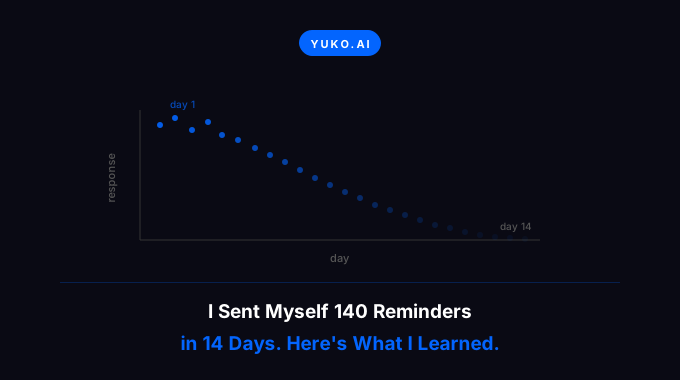
140 reminders. 14 days. One subject. Not a clinical trial, but enough signal to surface something I didn't expect to find as clearly as I found it.
The Setup
The tasks I chose were real: drafting a specific document, following up with a contact, doing a daily exercise I'd been meaning to establish, working on the Yuko product architecture, and spending focused time on a relationship I'd been neglecting through busyness. All were things I genuinely intended to do. All were things I had been inconsistently completing before the experiment began.
The reminder variables I manipulated were:
Timing: Fixed (same time every day) vs. variable (random within a defined window).
Channel: SMS, email, and a custom Telegram bot — rotated in different patterns across the two weeks.
Tone: Neutral/logistical ("Complete architecture doc"), warm/personal ("Hey — the Yuko architecture is the thing that unlocks everything else. Worth 30 min today?"), and humorous/light ("Your future self would really appreciate some work on this. Just saying.").
Context: With motivation ("Call Marcus — he's waiting on your input before he can move forward") vs. without ("Call Marcus").
I tracked every reminder with a timestamp, then logged whether I completed the associated task within two hours. I also noted my subjective response — whether the reminder felt intrusive, useful, easy to ignore, or actually motivating — though I tried not to let that influence behavior tracking.
What the Data Showed
The completion rate differences were larger than I expected.
Fixed-time reminders — the same message at the same time every day — had a completion rate of roughly 27% in the first three days. By day seven, it had dropped to 11%. By day twelve, it was effectively zero. I was dismissing them before I was fully conscious of having seen them.
Variable-time reminders — identical content, but arriving at unpredictable moments within a two-hour window — held a completion rate of around 48% across the full two weeks, with no meaningful decay. The unpredictability appeared to prevent the habituation that destroyed the fixed-time reminders.
Channel rotation made a measurable difference. Reminders that arrived through the same channel I had seen all week were less likely to produce action than ones that arrived through a channel I hadn't heard from recently. The first SMS after several days of email reminders had a noticeably higher completion rate than the fifth consecutive SMS.
Tone was the biggest variable. Neutral/logistical reminders had a completion rate of about 31% across the experiment. Warm/personal reminders performed at 54%. The humorous ones were inconsistent — high when my energy was good, ineffective when I was already stressed. The pattern suggested that humor works as a tone-setter but requires a receptive baseline.
The context condition was the clearest finding of the experiment. Reminders with motivational context — a brief, specific reason why this task mattered right now — outperformed context-free reminders by nearly two to one. A bare task label completed about 29% of the time. The same task with a concrete reason attached completed at 57%.
The Insight That Changed the Product
Going into the experiment, I expected to find that timing was the primary variable. The research I had read on optimal notification timing suggested that there were specific windows in the day when people were more responsive to cues — after completion of other tasks, during natural transition points, in the mid-morning cognitive peak.
Timing mattered. But it wasn't the primary variable. Context was.
The reminder that told me why something mattered — that connected the task to a specific person, consequence, or goal that I actually cared about — was doing something fundamentally different from the reminder that just named the task. It wasn't refreshing my memory. It was refreshing my motivation.
This distinction became the central design principle behind Yuko. The failure mode of conventional reminder apps isn't that they arrive at the wrong time or through the wrong channel. Those are real problems, and they're worth solving. But the deeper failure is that they treat tasks as database records rather than as living commitments with human stakes behind them.
A reminder that says "Work on Yuko architecture" is a database query. A reminder that says "The architecture doc is the one thing that lets you move to real development — 30 minutes today would unlock the next month" is a motivational intervention. Those are not the same category of tool, and they don't produce the same behavioral response.
What I Got Wrong
I should be honest about the limitations of a 14-day, single-subject experiment, because they are real.
I am a specific kind of person — someone building a product about this exact topic, which means I was both highly motivated to pay attention to the experiment and potentially biased toward finding the results I expected. The Hawthorne effect was operating in full force: knowing I was being tracked almost certainly increased my response rates across all conditions.
The tasks I chose were real but not randomly selected — they were the tasks I was already most motivated to complete, which means the experiment underrepresents the harder problem of tasks that are chronically avoided because they are genuinely aversive.
And fourteen days is not enough to study long-term habituation patterns or to capture the full cycle of motivational engagement and decay that plays out over months.
What the experiment gave me was not clinical certainty. It gave me signal strong enough to build on — directional evidence that the variables I believed mattered actually did matter, in roughly the proportions the underlying research would predict.
Why This Became the Foundation
Every product is built on a bet. The bet behind Yuko is that the most important variable in follow-through is not the sophistication of the task management system. It's the quality of the connection between the task and the motivation behind it — and the degree to which that connection is kept alive over time through variable, contextually intelligent nudges rather than static, predictable ones.
The experiment gave me enough data to believe that bet was right. The research gave me the mechanisms to explain why. And the experience of watching my own completion rate double when a reminder carried context — and collapse when it didn't — gave me the visceral conviction that this was a problem worth building a company around.
140 reminders. The most useful ones were not the most frequent ones, or the most urgent ones, or the ones that arrived at the optimal time. They were the ones that briefly, specifically, honestly reminded me why I actually cared.
Yuko is the product that came out of this experiment — an AI nudge engine that keeps the why alive. If you're building something and struggling to maintain your own follow-through, we'd love to have you in the early access group. yuko.ai