
The words a reminder uses aren't just packaging. They're the mechanism.
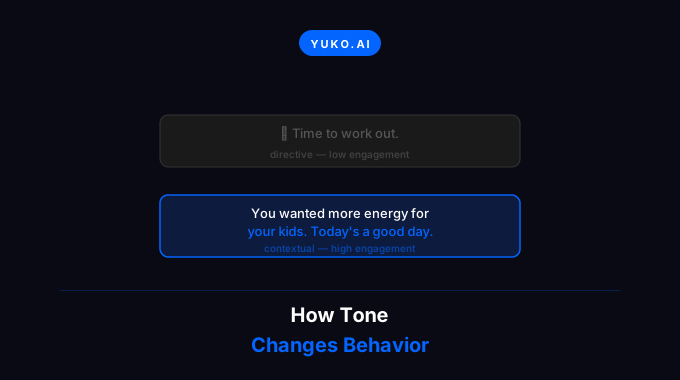
Imagine two messages arriving on your phone at the same moment, about the same task. The first says: "Reminder: Complete project proposal." The second says: "Your proposal could be the thing that changes this client's business — worth 30 minutes today?"
Both are reminders. Both reference the same task. The information content is essentially identical. But they will produce measurably different behavioral responses — not because one is louder or more prominent, but because they activate different psychological systems.
The tone of a reminder is not cosmetic. It is functional. The specific words, framing, emotional register, and degree of autonomy that a message conveys directly affect whether it produces action, avoidance, or nothing at all. The research on this is extensive and underappreciated. It has significant implications for how reminder systems should be designed — and for how we talk to ourselves about the things we're trying to do.
The Self-Determination Theory Foundation
The most robust framework for understanding how tone affects motivation comes from self-determination theory, developed by psychologists Edward Deci and Richard Ryan over four decades of research. SDT identifies three basic psychological needs — autonomy, competence, and relatedness — and argues that language and social environments either support or thwart these needs, with significant consequences for motivation and behavior.
Applied to reminders, the autonomy dimension is particularly important. Messages that feel controlling — that imply obligation, external pressure, or surveillance — tend to activate what SDT calls "controlled motivation": doing something to comply rather than because it aligns with your values or feels genuinely chosen. Messages that feel autonomy-supportive — that acknowledge your agency, invite reflection, or connect the task to your own stated goals — tend to activate "autonomous motivation": doing something because it is genuinely yours.
The behavioral consequences of this distinction are substantial. Research consistently finds that controlled motivation produces behavior in the short term but undermines intrinsic motivation over time. Autonomous motivation produces more durable behavior change, higher-quality performance on tasks requiring creativity or judgment, and greater persistence in the face of obstacles.
A reminder that says "You need to do this" and a reminder that says "You said this matters to you — here's why today might be the right moment" are both nudges toward the same behavior. But they are activating different motivational systems, with different consequences for what happens next — and for how you feel about the task afterward.
The Critical Inner Voice Problem
There is a specific tone dynamic in self-directed reminders that is worth examining carefully: the way people habitually talk to themselves about their own goals and shortcomings.
Research by psychologist Kristin Neff on self-compassion has documented a pervasive pattern: when people fail to follow through on their goals, the self-talk that follows tends to be significantly harsher than the language they would use toward a friend in the same situation. "I can't believe I didn't do this again. I'm so undisciplined. What's wrong with me?" is a common inner register that few people would direct at someone else.
This matters for reminders because a reminder that arrives in the context of a history of non-completion activates this critical inner voice. The notification appears; the brain registers it as another instance of the pattern it has come to associate with self-criticism; and the result is not motivation to act but avoidance of the discomfort the task has come to represent.
The reminder becomes associated with the self-criticism, not the task. And the brain, being an efficient avoidance machine when it comes to pain, learns to tune out the reminder as a way of tuning out the self-criticism.
This is why a reminder system that doesn't adapt to a user's failure-to-complete pattern is not neutral. By continuing to fire the same reminder in the same tone regardless of whether action has occurred, it is reinforcing a negative feedback loop between the reminder, the self-critical response, and the avoidance behavior.
Framing Effects in Behavioral Motivation
Independent of self-determination theory, there is a substantial literature on framing effects — the finding that the same information, presented in different ways, produces significantly different decisions and behaviors.
The classic framing finding from Kahneman and Tversky's prospect theory is that losses loom larger than gains: people are more motivated by the prospect of losing something they have than by the prospect of gaining something equivalent. Applied to reminders, this suggests that "don't lose the progress you've made" is structurally more motivating than "make more progress."
But framing effects go beyond gain/loss. Research on regulatory focus theory, developed by Tory Higgins, distinguishes between promotion-focused framing (emphasizing gains, aspirations, and ideals) and prevention-focused framing (emphasizing safety, obligations, and avoiding losses). Different people have different dominant regulatory focus orientations, and they respond more strongly to messages that match their orientation.
A reminder system that uses the same tone for everyone is leaving this variability unaddressed. One user may respond strongly to "You're closer to your goal than you think — push today." Another may respond better to "You've been consistent for six days — don't break the pattern now." Both are nudges toward the same behavior; both are calibrated to different motivational profiles.
Warmth, Humor, and the Unexpected
There is a third dimension of tone that is rarely discussed in productivity literature but is well-supported by the psychology of persuasion and social influence: warmth.
Research on the warmth-competence tradeoff in social perception consistently finds that messages from sources perceived as warm are more likely to be acted upon than messages from sources perceived as merely competent or authoritative. This is true even when the source is a software system rather than a human — people anthropomorphize their tools to a significant degree, and a tool that communicates with warmth is perceived as more trustworthy and its suggestions more worth following.
A reminder that feels like it comes from something that understands your situation and genuinely wants you to succeed is structurally different from one that feels like a database query. The information content may be identical, but the motivational response will not be.
Humor is a related variable. Research on health communication finds that messages delivered with appropriate levity are more likely to be remembered and acted upon than equivalent messages delivered in a neutral or formal register. A reminder that makes someone smile before it makes them act has overcome the avoidance response before it begins — the emotional state the message induces precedes and shapes the behavioral response.
These findings are not arguments for reminder systems that are uniformly warm or humorous. Tone mismatch — a lighthearted nudge when the stakes are high, an authoritative nudge when the user has explicitly asked for a gentle approach — can backfire. The implication is that tone should be adaptive, not uniform: calibrated to the person, the task, the context, and the history.
The Variable Tone Argument
The convergence of these research streams points toward a clear design principle: the most effective reminder systems will vary their tone systematically rather than delivering the same register in every message.
This is true for the habituation reason described elsewhere: the same tone, repeated enough times, becomes invisible as the brain models it and routes it around conscious attention. But it is also true for the motivational reason: different tasks, different moments, and different emotional states call for different approaches. The reminder that cuts through on a tired Tuesday afternoon is not the same one that works on a motivated Monday morning.
A system that rotates through registers — warm on some days, direct on others, humorous occasionally, reflective when the moment calls for it, urgent when the deadline genuinely warrants it — cannot be habituated to and cannot be dismissed as irrelevant. It arrives with a voice that feels alive rather than automated, and that aliveness is itself motivationally significant.
The words aren't just packaging. In a reminder, the words are almost everything.
Yuko is building the first AI nudge engine that adapts its tone to the person, the task, and the moment — because how a reminder speaks changes whether it works. Learn more at yuko.ai