
The behavioral science of why we systematically avoid the work that matters most
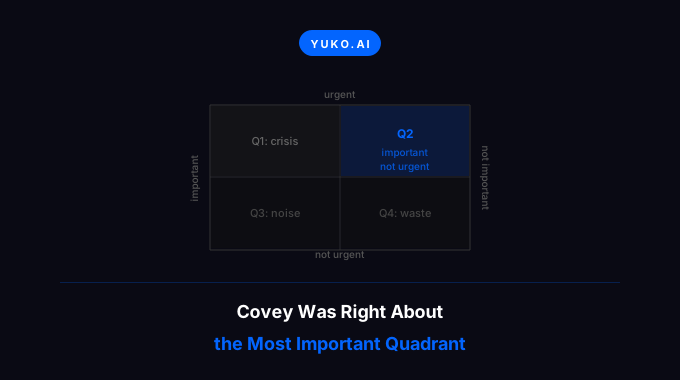
In 1989, Stephen Covey introduced the Eisenhower Matrix to a mass audience in The 7 Habits of Highly Effective People. The framework divides tasks into four quadrants along two axes — urgency and importance — and argues that most people spend too much time in the urgent quadrants and not enough in Quadrant 2: important, not urgent.
Covey called Q2 the quadrant of quality. It is where careers are built in the margins before they become obvious. Where health is maintained before it becomes a crisis. Where relationships are nurtured before they fracture. Where learning happens before the skill is urgently needed. Every long-term outcome worth having is built, piece by piece, in Q2 — through actions that are too easy to defer today because they generate no immediate pressure.
Covey was right. The behavioral science of the decades since his book has confirmed the basic insight with more rigorous mechanisms than he had available. And yet, for most people, Q2 work remains perpetually deferred, the victim of a predictable set of cognitive biases that no time management framework has found a reliable way to counteract.
The Urgency Bias Is Not a Character Flaw
The tendency to prioritize urgent tasks over important ones is not laziness or poor discipline. It is a predictable consequence of how the brain evaluates competing demands.
Research on the "mere urgency effect" — documented by Meng Zhu, Yang Yang, and Christopher Hsee in a 2018 paper — found that people consistently choose urgent tasks over important ones, even when the important tasks offer higher payoffs, simply because urgency creates a feeling of time pressure that is intrinsically motivating. The ticking clock is a cue that triggers action. The Q2 task, with no deadline, generates no such cue.
This is not irrational at the neural level. The brain's threat-response systems evolved in an environment where immediate signals — the rustle in the bushes, the angry face, the spoiling food — genuinely required immediate attention. The urgent task activates these systems in a mild but real way. The Q2 task, being neither immediate nor threatening, does not. The brain's response is proportional to the signal it receives, not to the actual importance of the outcome.
The availability heuristic compounds this effect. Research by Kahneman and Tversky established that people assess the probability and importance of events based on how easily examples come to mind. Urgent tasks come to mind easily — they appear in inboxes, notifications, and conversations. Q2 tasks do not arrive in any inbox. They live in intentions and vague commitments that are easy to defer because they generate no visible consequence for deferral, at least not today.
The Present Bias Problem
The most important cognitive mechanism underlying Q2 neglect is present bias — the documented tendency to overweight costs and benefits in the present relative to equivalent costs and benefits in the future.
Behavioral economists have measured present bias with considerable precision. Research by Laibner, O'Donoghue, and Rabin on hyperbolic discounting shows that people discount future rewards at a rate that is inconsistent with their stated preferences. Most people report valuing their long-term health, relationships, and career development highly. But when asked to choose, in the moment, between an activity that serves those long-term goals and one that provides immediate relief from an urgent demand, they consistently choose the urgent option — despite knowing, abstractly, that the long-term goal is more important.
This is the Q2 trap in its purest form. The rational agent in every of us knows that thirty minutes of work on the business plan today will matter more in five years than thirty minutes of email processing. The present-biased agent in all of us finds reasons, in the moment, to process the email — because the email is there, it has a deadline implied by recency, and the business plan will still be there tomorrow.
It will be there tomorrow. And tomorrow. And tomorrow.
The Compounding Cost of Q2 Neglect
The insidious feature of Q2 neglect is that its costs are invisible in the short term. Missing one workout does not produce a health crisis. Skipping one learning session does not produce a skill gap. Failing to work on the long-term project on one particular Tuesday does not produce an obvious consequence.
The costs are only visible in retrospect — in the body that declined slowly while the urgent demands were managed, in the skill that wasn't developed before it was needed, in the relationship that eroded while there were always other things to attend to first, in the career that plateaued because the foundational work was never done.
This is the temporal mismatch that makes Q2 work so difficult to prioritize. The cost of avoidance is deferred and diffuse; the cost of urgency response is immediate and concrete. The brain's threat-detection systems are sensitive to immediate, concrete costs. They are poorly calibrated to diffuse, deferred ones.
Covey understood this intuitively. The behavioral science tells us that the bias toward urgency is not merely a bad habit to be corrected with better intention. It is a structural feature of how the brain makes decisions under competing demands — one that requires deliberate countermeasures to overcome.
Why Most Solutions Fail
The standard advice for addressing Q2 neglect is time blocking — scheduling specific time for Q2 activities in advance, treating those appointments with the same seriousness as external commitments. This advice is sound as far as it goes. Pre-commitment devices are effective precisely because they shift the decision from the biased present moment to a calmer planning moment, when long-term preferences are more accessible.
The problem is that time blocking without behavioral support tends to erode. The Q2 block on Tuesday morning meets the urgent demand that arrived Monday afternoon. The important project that was scheduled meets the meeting that couldn't be moved. Time blocks are intentions; urgency is force.
What's missing from the time-blocking approach is ongoing behavioral support — something that actively counteracts the urgency bias in the moments when it activates, by making the Q2 goal vivid and its stakes concrete. Not just a calendar block that says "Deep Work" but a nudge that says "This is your Q2 hour — your strategic project is the thing that will still matter in five years. The emails will still be there at 4pm."
The difference between a calendar block and a behaviorally intelligent nudge is the difference between a plan and a support system. Plans are made at planning time, when long-term preferences are salient. Support systems operate at execution time, when present bias is active and urgency is competing for attention.
Reclaiming Q2
The first step in addressing Q2 neglect is the one Covey actually prescribed: becoming aware of where your time actually goes, not where you intend it to go. Tracking one week of work honestly — not as you hope it looks, but as it actually is — typically reveals a significant gap between stated priorities and actual time allocation. Most people are spending far more time in Q1 (urgent and important — managing crises) and Q3 (urgent but not important — responding to other people's priorities) than they intend to.
Awareness creates the conditions for change but doesn't produce it. The change requires redesigning the environment — the cues, nudges, timing signals, and social contexts — to make Q2 work as accessible and as salient as urgent work. It requires making the long-term consequences of Q2 neglect vivid at the moment of decision, when the brain is otherwise focused on the urgent signal.
It requires, in short, the kind of behaviorally aware support that Covey's framework describes but cannot itself provide — because a framework is static, and urgency bias is dynamic, activating in specific moments that no framework can fully anticipate.
Q2 is where the most important work lives. Getting there consistently requires more than knowing that. It requires a support system designed for the moments when knowing isn't enough.
Yuko is building the first AI nudge engine designed to surface Q2 work at the right moment — making the important feel as pressing as the urgent. Learn more at yuko.ai