
Ask someone why they failed to follow through on a goal and they will almost always give you the same answer. They forgot. They got busy. Life got in the way. It is a tidy explanation, and it lets everyone off the hook — the person, the app they were using, and the whole industry built around the premise that human failure is fundamentally a memory problem.
It is also, in most cases, wrong.
Forgetting is a convenient story. It is legible, blameless, and fixable — just set another reminder. But if forgetting were truly the culprit, reminder apps would have solved the follow-through problem by now. They have been around for decades, they are on every device, they are free, and they are easy to use. And yet the research on habit formation, goal completion, and behavioral follow-through tells a consistent story: most people abandon their intentions not because the reminder failed to fire, but because by the time it did, they no longer felt the pull of the goal behind it.
The reminder arrived. The motivation had already left.
What the Brain Actually Does With Reminders
To understand why forgetting is the wrong diagnosis, it helps to understand what the brain does when it encounters a repeated stimulus. The neuroscientist Evgeny Sokolov first described the orienting response in the 1960s — the automatic, involuntary attention the brain directs toward anything new or unexpected. Heart rate shifts. Pupils dilate. Cognitive resources are allocated. The brain is saying, in effect: this might matter.
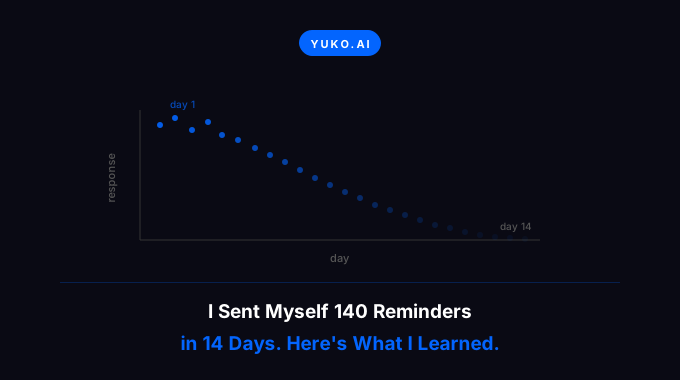
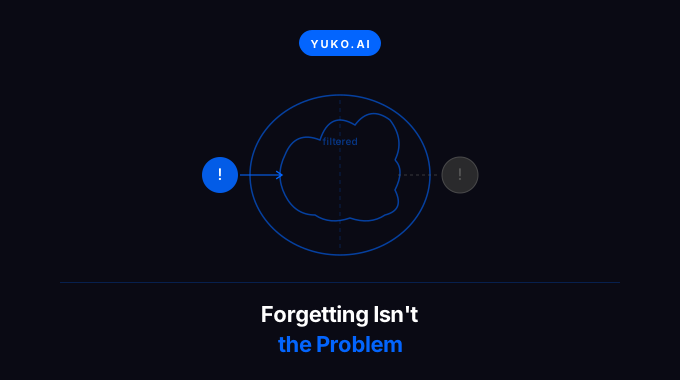
But the orienting response is not unconditional. It is triggered by novelty and suppressed by familiarity. When the brain encounters the same stimulus repeatedly — same time, same tone, same visual pattern — it begins a process called habituation. The orienting response weakens. The stimulus is reclassified from signal to background noise. The brain has learned, efficiently and correctly, that this particular input does not require its full attention.
This is not a failure of memory. The person sees the reminder. They register it. They dismiss it. The problem is not that the notification went unnoticed — it is that it arrived without any of the psychological weight it once carried.
The Difference Between Seeing and Feeling
There is an important distinction that reminder apps consistently collapse: the difference between cognitive awareness of a goal and emotional engagement with it.
You can be fully aware that you intended to meditate every morning, to call your father more often, to work on your novel for thirty minutes a day. The information is present. The intention is remembered. But awareness without felt motivation is inert. It produces recognition without action — the quiet guilt of someone who knows exactly what they should be doing and cannot summon the energy to begin.
Psychologist Peter Gollwitzer's decades of research on implementation intentions makes this concrete. People who form vivid, specific mental connections between a situation and an intended behavior — not just "I will exercise" but "when I sit down with my morning coffee, I will put on my running shoes" — follow through at dramatically higher rates. The difference is not memory. It is the psychological aliveness of the intention. The goal has to feel real, felt, and connected to something that matters in order to generate action.
A notification that says "Time to work out" at 7am does not renew that connection. It surfaces a label. The emotional content that originally motivated the goal — the reason it mattered, the version of yourself you were reaching toward — is nowhere in it.
The Forgetting Myth Serves the Wrong Incentives
There is a reason the reminder app industry has been slow to question the forgetting assumption. It is a profitable premise. If the problem is forgetting, the solution is more reminders, more notifications, more engagement, more time in the app. The business model and the diagnosis reinforce each other neatly.
But if the real problem is motivational decay — the slow erosion of a goal's psychological power through familiarity and repetition — then more reminders do not help. They accelerate the problem. Every habituated notification is another small vote cast by the brain that this goal is not worth attending to.
The honest version of the reminder app problem is harder to monetize and harder to build around. It requires asking not just whether the user saw the reminder, but whether the reminder did anything to keep the original intention alive. Whether it arrived at the right moment. Whether it reframed the goal in a way that felt fresh. Whether it connected the task to the why behind it rather than simply restating the what.
These are not notification problems. They are behavioral design problems.
What Would Actually Help
If forgetting is not the enemy, what is the right target? The answer is motivational continuity — the ongoing, renewable sense that a goal is worth pursuing and that now is a meaningful moment to act on it.
This looks different from a reminder. It might be a message that reframes why you set the goal in the first place. It might arrive at an unexpected time, breaking the pattern your brain has learned to ignore. It might connect today's small action to a larger vision of who you are becoming. It might simply ask a question rather than issue a directive.
None of this is magic. It is the application of what behavioral science has understood for years about how humans sustain motivation over time. The brain does not need to be reminded. It needs to be re-engaged.
That is a different product. It requires a different philosophy. And it starts by letting go of the comfortable fiction that the problem was forgetting all along.
This article is part of a series. Read the full argument in We've Been Building Reminder Apps Wrong.
Yuko is an anti-habituation nudge engine built to keep your goals psychologically alive. Learn more at yuko.ai.