
At some point, most people have done a version of the same thing. A goal is not getting traction, so they add another reminder. Maybe a second one in the afternoon to back up the morning one. Maybe a daily check-in notification on top of the weekly one. The logic feels sound: if one reminder is not working, more coverage should help.
It does not help. In most cases, it makes things measurably worse.
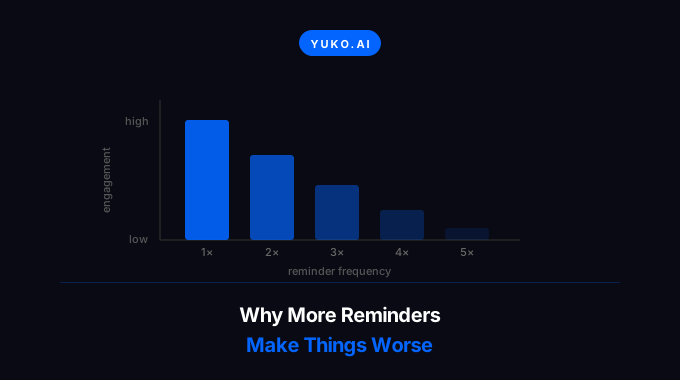
This is one of the most counterintuitive findings in behavioral design, and one of the most consistently ignored by the apps that are supposed to be helping us. The relationship between reminder frequency and follow-through is not linear. It does not scale upward. Past a very low threshold, more reminders produce less engagement, not more — and the mechanism behind this is not laziness or poor intentions. It is basic neuroscience.
The Brain's Filtering System
The human brain receives an enormous amount of sensory and informational input at every moment. To function, it must decide in real time what deserves conscious attention and what can be safely ignored. This filtering system is not optional and it is not slow. It operates continuously, below the level of conscious awareness, and it is extremely good at its job.
One of its core heuristics is repetition. When a stimulus appears repeatedly without consequence — without anything novel, rewarding, or threatening attached to it — the brain downgrades it. This is the process of habituation, and it operates across every sensory modality. Sounds, images, physical sensations, and yes, notifications. The brain is not making a judgment about whether the reminder is important. It is making an observation about whether this particular signal has historically required a response. If the answer is usually no, the signal gets filtered.
This is why your phone's notification sound startles you the first few times you hear it on a new device, and within days becomes completely invisible. The sound did not change. Your brain's classification of it did.
Every reminder you add to your system is a new candidate for this filtering process. And the more frequently a reminder fires, the faster it habituates.
Frequency Is the Accelerant
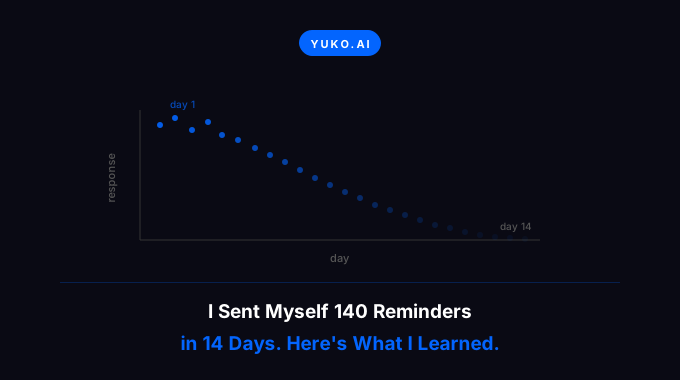
If a single daily reminder habituates over weeks, a reminder that fires three times a day habituates in days. The rate of habituation is not fixed — it scales with exposure. The brain learns the pattern faster when it encounters it more often.
This creates a trap that many productivity-minded people fall into. The reminder stops working, so they add another one. The new reminder works briefly — novelty briefly restores the orienting response — and then habituates faster than the first one did. The system grows more cluttered and less effective simultaneously.
There is also a secondary effect that is less discussed but equally damaging. When reminders habituate and get dismissed repeatedly, the dismissal itself becomes automatic. The gesture — swipe, tap, clear — becomes a reflex. The brain is not just ignoring the reminder. It is actively training itself to process and eliminate it without engagement. At that point the reminder is not neutral noise. It is a rehearsal of avoidance.
Every dismissed notification is, in a small way, practice at not doing the thing.
The Notification Research Is Not Ambiguous
The empirical picture here is fairly clear, even if the app industry has been reluctant to act on it. Studies on notification fatigue consistently find that high notification volume reduces engagement rates, increases dismissal rates, and correlates with users turning off notifications entirely. Research on interruption costs in productivity contexts shows that frequent, low-value interruptions degrade both performance and the subjective sense of progress.
A 2020 study on mobile health applications — apps designed to support behavior change around exercise, diet, and wellness — found that notification frequency was negatively correlated with long-term engagement. Users who received more frequent reminders were more likely to abandon the app within thirty days than users who received fewer, better-timed ones. The apps sending more notifications were, in effect, accelerating their own abandonment.
This is not an isolated finding. It is a consistent pattern across contexts, and it points toward a conclusion that the reminder app industry has structural incentives to ignore: the goal is not to maximize notification volume. The goal is to maximize the number of times a reminder lands with enough force to actually move someone.
Those are very different optimization targets.
Less, But Better
The principle that emerges from the research is not complicated, though it is harder to build around than a simple scheduler. Fewer reminders, arriving less predictably, with more contextual relevance, outperform frequent reminders on every meaningful metric. Not just engagement rates — actual behavior change.
The word that matters here is unpredictability. A reminder that arrives at a time the user cannot anticipate retains its ability to trigger the orienting response. The brain cannot habituate to a pattern it has not learned. An unexpected nudge at 2pm on a Tuesday, framed differently from the last one, connected to the specific reason the user set the goal in the first place, lands differently than the eighth reminder this week at the same time with the same message.
This requires more from the system delivering the reminder. It cannot just be a scheduler. It has to understand the goal, the user's history with it, what framing has worked before, and what moment of the day is most likely to produce a genuine decision rather than a reflexive dismissal.
That is harder. It is also the only approach that does not eventually make things worse.
The Honest Conversation
There is a version of this that every reminder app user has lived through. You set up the system carefully. It works for a while. Then it stops working, and instead of questioning the approach, you add more. More reminders, more categories, more complexity. The system grows and your follow-through does not. Eventually you abandon the whole thing and feel vaguely like the failure, when the design was the problem from the beginning.
More reminders make things worse because the brain is not a passive recipient of instructions. It is an active filter that learns from every interaction. Feed it repetitive, low-consequence signals and it will learn, quickly and efficiently, to treat those signals as noise.
The path forward is not more. It is smarter — fewer touchpoints, higher relevance, and enough variability to keep the brain from ever fully habituating to the pattern.
This article is part of a series. Read the full argument in We've Been Building Reminder Apps Wrong.
Yuko is an anti-habituation nudge engine built to keep your goals psychologically alive. Learn more at yuko.ai.