
There is a version of you that woke up one morning with a clear intention. Maybe it was to exercise more consistently, to finally finish that course, to call your mother every Sunday, to drink more water, to spend less time on your phone. You opened an app, set a reminder, and felt the quiet satisfaction of having done something about it.
And then, over days and weeks, you stopped noticing the reminder entirely.
Not because you forgot to look. Not because your phone was on silent. But because your brain, one of the most sophisticated pattern-recognition systems ever to exist, simply learned to ignore it.
This is the fundamental problem with reminder apps — and almost no one building them is talking about it.
The Wrong Diagnosis
The entire reminder app industry is built on a single assumption: that people fail to follow through because they forget. It's an intuitive assumption. It's also largely wrong.
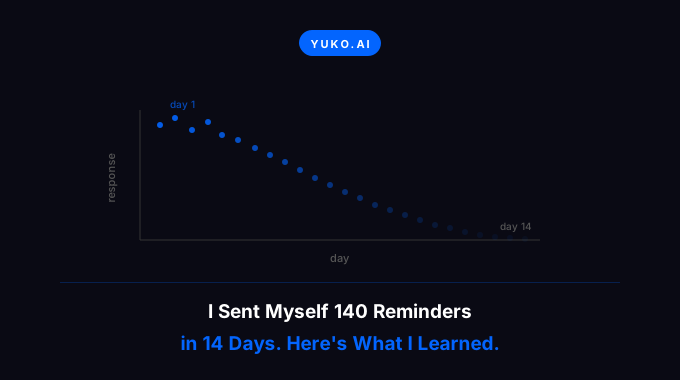
Research in behavioral neuroscience tells a different story. The brain does not treat all incoming stimuli equally. It is constantly running a background process that evaluates what is new, what is meaningful, and what can safely be filtered out. When a stimulus repeats — same time, same sound, same visual pattern — the brain progressively reduces its response. This is called habituation, and it is not a bug in human cognition. It is one of its most important features.
Habituation is why you stop noticing the hum of an air conditioner minutes after you enter a room. It is why you can sleep through traffic noise in a city but wake instantly to an unfamiliar sound. The brain learns what is safe to ignore, and it learns fast.
Reminder apps, almost by design, train your brain to ignore them.
What Repetition Actually Does
Consider what happens when you set a daily 8am reminder to work on your novel. The first morning, it surfaces with a small jolt of intention. You feel it. You maybe even act on it. By the end of the first week, you are dismissing it before you are fully awake. By the end of the first month, it has become indistinguishable from the notification telling you someone liked your photo. Same motion. Same dismissal. Zero friction, zero meaning.
The reminder has not failed because you forgot. It has failed because it became invisible through repetition.
This is the same reason a smoke alarm going off in a restaurant kitchen briefly stops conversation but is ignored entirely by the third occurrence. The alarm did not get quieter. The humans simply habituated.
A reminder app that fires on a fixed schedule is not a productivity tool. It is a countdown to irrelevance.
The Assumption Nobody Questions
If forgetting is not the core problem, what is? The answer is that the goal — the original intention that prompted the reminder — lost its psychological aliveness. It faded from something felt to something filed.
Most reminder apps treat goals as data. You type them in, assign a time, and the app dutifully surfaces them on schedule. But goals are not data. They are emotional commitments that require ongoing renewal to stay motivating. The research of psychologist Peter Gollwitzer on implementation intentions shows that people are far more likely to follow through when they maintain a vivid, specific connection to their intended behavior — not just a label for it.
A reminder that says "Work out" at 7am every day does nothing to renew that connection. It is a label, not a prompt. It surfaces the what while the why — the reason you wanted to build that habit in the first place — quietly disappears.
The most important thing to keep alive is not the task. It is the intention behind it.
What Actually Works
Decades of behavioral research point toward a counterintuitive conclusion: unpredictability sustains attention far more effectively than consistency.
The principle comes from the study of variable ratio reinforcement schedules — the same mechanism that makes slot machines so compelling. When a reward or stimulus arrives on a fixed, predictable schedule, the brain optimizes around it and reduces engagement between occurrences. When the same stimulus arrives unpredictably, the brain stays alert. It cannot habituate to something it cannot anticipate.
Applied to reminders, this means that a nudge arriving at an unexpected time, in an unexpected form, carrying an unexpected framing of your goal, will land with more force than ten reminders sent at 8am every morning. Not because surprise is gimmicky, but because surprise is one of the few things the brain's habituation filter cannot neutralize.
This is the design principle that almost no reminder app has been built around — because it is harder to build than a cron job, and the industry defaulted to what was technically simple rather than what was behaviorally effective.
Rebuilding From First Principles
If you strip away every inherited assumption and ask what is fundamentally, provably true about human follow-through, you arrive at a short list.
People do not fail because they forget. They fail because the goal loses meaning. Repetition accelerates that loss. Unpredictability slows it. The medium matters less than the moment. And the most powerful thing any system can do is keep the original intention — the why — psychologically present and felt, not just stored and surfaced.
A reminder app built on these truths would look different from everything that currently exists. It would not fire on a fixed schedule. It would not treat all goals the same way. It would not mistake notification volume for effectiveness. It would understand that its job is not to remind you that a task exists — it is to keep the person you are trying to become vivid enough that you choose to act.
That is a meaningfully harder problem. It is also the only problem worth solving in this space.
Why This Matters Now
We are living through a notification crisis. The average person receives dozens of app notifications per day, and the research on notification fatigue is unambiguous — volume destroys signal. In that environment, another reminder app that fires on a schedule is not a solution. It is more noise.
The apps that will matter in the next decade are the ones that understand attention as a finite and precious resource, and that earn it through relevance and timing rather than frequency and persistence. The ones built on the assumption that the human brain is not a passive receiver waiting to be pinged, but an active filter constantly deciding what deserves its engagement.
Yuko was built on that premise. Not as a smarter scheduler, but as a system designed from the ground up to work with the brain's natural patterns rather than against them — delivering nudges that are variable, contextually aware, and anchored to the intention behind the goal, not just the goal itself.
The reminder app you set up and forgot about was not a failure of your willpower. It was a failure of design.
Want to go deeper? This article is the foundation of a series:
- Forgetting Isn't the Problem
- Why More Reminders Make Things Worse
- The Slot Machine Principle
- Your App Should Know Your Why, Not Just Your What
Yuko is an anti-habituation nudge engine built to keep your goals psychologically alive. Learn more at yuko.ai.