
The counterintuitive neuroscience of why your most reliable habit is making you worse at follow-through
There's a common belief embedded in every productivity app ever built: that the problem with follow-through is forgetting, and the solution is a well-timed reminder. Set it once, make it recurring, and the system takes care of the rest.
This belief is wrong. And the damage it does isn't neutral — it's actively subtractive. A recurring reminder that goes unacted upon doesn't leave you where you started. It leaves you measurably worse off than if you'd never set the reminder at all.
That's not a provocation. It's a description of how your nervous system actually works.
The Notification That Cried Wolf
Most people are familiar with the fable of the boy who cried wolf — a child who raises false alarms so many times that when a genuine threat arrives, nobody responds. What most people don't recognize is that their reminder app is running the same experiment on their brain, dozens of times a day.
Every time you receive a reminder and don't act on it, your brain logs a data point. Not consciously, not deliberately — but your nervous system is a pattern-recognition machine, and it notices when stimuli are systematically unconnected to consequences. A notification that arrives without action, again and again, becomes categorized by the brain not as a meaningful signal but as ambient noise.
Neuroscientists call this process learned irrelevance. It was first described in animal learning research and has since been documented extensively in human attention studies. When a stimulus is repeatedly presented without a meaningful outcome, the brain doesn't just stop responding to it — it actively suppresses the response. This is deeper than simple habituation. Habituation is forgetting to notice something. Learned irrelevance is learning that something isn't worth noticing.
The distinction matters. Habituation can be disrupted by novelty. Learned irrelevance is stickier — it takes active counter-conditioning to reverse. Once your brain has classified a particular kind of reminder as a non-signal, re-sensitizing it requires either changing the stimulus substantially or pairing it consistently with action over an extended period.
This is why the advice to "set better reminders" misses the point. The problem isn't the quality of any individual reminder. It's the accumulated track record of all the reminders you've ever ignored.
The Phantom Vibration Problem
In 2012, researcher Michael Rothberg published a study on what he called "phantom vibration syndrome" — the experience of feeling your phone buzz when it hasn't. The study found that 68% of medical residents reported experiencing phantom vibrations. Later research extended this finding to the general population, with similar rates across contexts.
What's interesting about phantom vibrations isn't the perceptual error itself. It's what the phenomenon reveals about how the brain handles high-frequency, low-consequence alerts. The residents in Rothberg's study were receiving so many notifications — pages, alerts, updates — that their sensory cortex had essentially pre-loaded the vibration pattern as a baseline expectation. The brain was completing a pattern it had learned to expect, even in the signal's absence.
Run this insight in reverse, and you get the recurring reminder problem. When a stimulus is frequent enough and inconsequential enough, the brain doesn't heighten its sensitivity to it — it builds a model that predicts and then suppresses the signal before it reaches conscious awareness. You're not ignoring your 9am reminder because you're distracted. You're ignoring it because your brain has decided, on the basis of substantial evidence, that 9am reminders don't require attention.
This is the trap that recurring reminders set. The very feature designed to make them reliable — their consistency — is the mechanism by which they become invisible.
What Actually Happens in Your Brain When You Dismiss a Reminder
Walk through the neuroscience of a single ignored reminder, and the problem becomes clear.
When a novel stimulus arrives — a sound, a vibration, a flash of light — the brain's ascending arousal system generates an orienting response. Attention shifts. Heart rate adjusts slightly. The prefrontal cortex begins evaluating whether the stimulus warrants a behavioral response. This is the biological substrate of "noticing something."
When that same stimulus has been presented repeatedly without consequence, the thalamus — the brain's sensory relay station — begins filtering it before it reaches cortical processing. The stimulus arrives; the thalamus recognizes the pattern; the signal is attenuated before it ever generates an orienting response. The notification buzzes. You don't notice it in any meaningful sense. And critically, you don't notice that you didn't notice.
But there's a second-order effect that's less discussed. Each acted-upon cue strengthens the neural pathway between that cue and the behavior it's meant to trigger. Each ignored cue weakens it. This is basic Hebbian learning — neurons that fire together wire together, and neurons that consistently fail to fire together wire apart.
A reminder you consistently ignore isn't just failing to help you. It's actively eroding the association between the cue and the intended behavior. After enough repetitions, the presence of the reminder may actually suppress the behavior by triggering an automatic dismissal response — a conditioned non-action.
This is the paradox at the center of reminder culture: the more you rely on a reminder you ignore, the less likely you are to ever act on it.
The Gym Membership Analogy
Think about the psychology of an unused gym membership. Research on what behavioral economists call "sunk cost neglect" consistently shows that people who maintain unused memberships often feel, paradoxically, more at peace with not going to the gym than people who cancelled their memberships entirely.
The membership functions as what psychologists call a "commitment device substitute" — a signal that the intention exists, which partially relieves the psychological discomfort of inaction without requiring any actual action. The membership absorbs the anxiety so the behavior doesn't have to.
Recurring reminders work the same way. Setting a reminder for a task you're avoiding provides a small but real sense of having addressed the task. The reminder becomes a proxy for intention. And because intention and action are processed by different neural systems — the prefrontal cortex handles planning, the basal ganglia handles execution — it's possible to satisfy the planning system entirely while the execution system remains unengaged.
This is why productivity researchers have found that people with more reminders set don't necessarily complete more tasks. In some studies, they complete fewer — because the act of organizing reminders substitutes psychologically for the act of doing the work.
The Counterintuitive Fix
If recurring reminders make things worse, what's the alternative? The answer isn't fewer reminders — it's different reminders. Specifically, reminders designed around the neuroscience of attention rather than the logic of calendars.
The research on variable ratio reinforcement — the same principle that makes slot machines compelling — suggests that unpredictable timing dramatically increases the orienting response. A reminder that arrives at a slightly unexpected moment, in a channel you weren't anticipating, with phrasing you haven't seen before, cannot be pre-filtered. The thalamus hasn't built a model for it. It lands in conscious awareness the way a novel stimulus is supposed to.
Similarly, reminders that carry contextual information — not just "do X" but "do X because Y matters to you right now" — engage the prefrontal cortex's prospective memory systems rather than the habituated stimulus-response loop. They ask the brain to evaluate, not just recognize. Evaluation is harder to suppress.
The practical implication is this: a reminder system that rotates its phrasing, varies its timing within a window, changes its delivery channel, and attaches motivational context to each nudge will systematically outperform a recurring alarm set to fire at 9am every day — not because it's louder, but because it's unpredictable. And unpredictability, at the neural level, is the definition of a signal worth processing.
This is not an argument for chaos. It's an argument for designing reminder systems the way attention actually works, rather than the way calendars work. The recurring reminder is a calendar solution to a neuroscience problem. That mismatch is the source of the failure.
The Honest Accounting
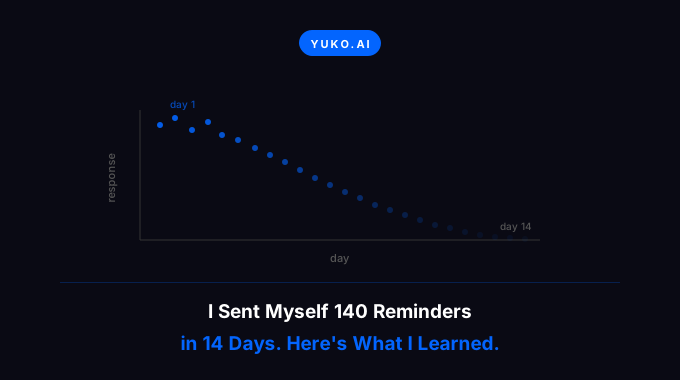
Here's a useful thought experiment: take every recurring reminder you currently have set and ask, honestly, what percentage of them you act on. For most people, the number is low — often below 30% for reminders older than two weeks. Now consider what the brain has learned from that track record.
It has learned that this class of stimuli — these apps, these notification patterns, this timing — is not worth the metabolic cost of full attentional processing. It has learned, through repetition, to treat your most carefully curated reminder system as background noise.
Resetting that association requires more than a new reminder. It requires a new kind of reminder — one that doesn't give the brain enough consistency to model and suppress. One that treats attention as the scarce resource it actually is, rather than assuming it will be available on demand at 9am every weekday.
The recurring reminder, for all its apparent logic, is built on a false premise: that the brain is a passive recipient of information, ready to be activated by the right alert at the right time. The brain is not passive. It is constantly predicting, filtering, and modeling the world — and any reminder system that fails to account for that will eventually be modeled away.
Set fewer recurring reminders. Make the ones you keep unpredictable. Give them context. And track your actual follow-through rate — because the number will tell you everything about what your brain has already decided your reminders are worth.
Yuko is building the first AI nudge engine designed around how your brain actually works — variable timing, rotating tone, contextual motivation, and behavior-aware delivery across channels. Learn more at yuko.ai