
The Zeigarnik effect, open loops, and why your to-do list might be making you less productive
Right now, somewhere in your working memory, there is a task you haven't finished. You're not thinking about it consciously — you're reading this — but it's there. A thread left open. An email half-drafted. A decision deferred. A conversation you meant to have.
You can probably feel it if you try. That low-level hum of incompleteness that sits just below conscious attention, consuming cognitive resources without generating any useful output. Psychologists have a name for it: the Zeigarnik effect. And it explains more about why to-do lists fail than almost any other phenomenon in the behavioral science of productivity.
Bluma Zeigarnik and the Interrupted Waiter
In the late 1920s, Lithuanian psychologist Bluma Zeigarnik was sitting in a Vienna café when she noticed something that her supervisor, the pioneering gestalt psychologist Kurt Lewin, had casually observed: waiters seemed to remember open orders with remarkable accuracy, but forgot them almost immediately after the bill was paid.
Zeigarnik went back to the lab and ran the experiment properly. She gave participants a series of tasks — puzzles, arithmetic problems, handicrafts — and interrupted them midway through some while letting them complete others. When she tested recall afterward, participants remembered interrupted tasks nearly twice as well as completed ones.
The explanation, which Lewin had theorized and Zeigarnik confirmed, was that incomplete tasks generate a kind of psychological tension — a sustained cognitive activation that keeps them in accessible memory until they are resolved. Completed tasks release that tension and fade from active attention. The brain, it turns out, treats unfinished business as unfinished business.
This is adaptive in the short term. The Zeigarnik effect keeps you from forgetting what you were doing when you were interrupted. It is a useful feature for a species that frequently needs to return to incomplete tasks in a dynamic environment.
It becomes maladaptive when the number of open loops exceeds what the brain can productively track — which, for most knowledge workers in 2026, happens before breakfast.
Your To-Do List Is Running Your Background Processes
Think of the brain's working memory as a computer's RAM. It has limited capacity, and every open process consumes some of it. A task you have committed to but not completed is, in the neurological sense, an open process — consuming memory resources even when it is not the focus of active attention.
A short to-do list with three items is manageable. The Zeigarnik tension generated by three incomplete tasks is motivating rather than overwhelming. You feel the pull of each one, and that pull helps you return to them.
A to-do list with forty-seven items is something else entirely. The accumulated Zeigarnik tension from dozens of open loops doesn't produce motivation — it produces cognitive noise. The brain is simultaneously tracking too many incomplete states to attend effectively to any of them. This is why people with long to-do lists often feel simultaneously overwhelmed and unproductive — they are devoting substantial cognitive resources to maintaining awareness of incompleteness while having insufficient bandwidth left to actually complete anything.
The to-do list promised to free your mind from the burden of remembering. What it actually does, without intelligent prioritization and ruthless curation, is transfer that burden from episodic memory to working memory — where it consumes far more cognitive resources and generates far more anxiety.
The Dopamine Economics of Completion
If incomplete tasks consume resources, completed tasks release them — and they do something else: they deliver a reward.
The brain's dopamine system responds to task completion in a way that is well-documented but often misunderstood. The popular notion of a "dopamine hit" from checking something off a list is approximately correct, but the neuroscience is more nuanced. Dopamine release in response to completion is not primarily about pleasure — it is about prediction error.
When you complete a task, the brain compares the outcome to its prediction. If the task was meaningful and the completion felt significant, the dopamine signal is strong. If the task was trivial — replying to a low-stakes email, deleting a file — the signal is proportionally weaker. This is why crossing something minor off a list feels good but doesn't feel as good as finishing something that actually mattered.
The implication is important for how to-do lists should be structured. A list full of small, easily-completed tasks can produce a steady stream of minor dopamine signals while leaving the genuinely important work untouched. This is the productivity trap that behavioral economists call completion bias — the tendency to prioritize tasks that can be completed quickly over tasks that are important but complex, because completion itself is rewarding regardless of what was completed.
Checking forty-seven emails while failing to make progress on the project that would change your career trajectory is not productivity. It is the dopamine economics of completion working against you.
The Overfull List as Avoidance Mechanism
There is a darker dimension to the long to-do list that productivity culture rarely acknowledges: it can function as an elaborate avoidance system.
A list that is genuinely too long to complete in any given day offers something psychologically valuable — an alibi. If everything on the list is "equally important," then the choice of what to work on today is arbitrary. And if the choice is arbitrary, then not working on the most difficult, most important, most personally risky item on the list is not avoidance — it's just prioritization.
This is not a conscious strategy. People don't deliberately build sprawling to-do lists to avoid their most important work. But the psychological function operates regardless of conscious intent. The overfull list provides cover. It turns avoidance into busyness, and busyness into a legitimate reason for not doing the thing that matters most.
The research on this phenomenon connects directly to the Zeigarnik effect. When the open loops are too numerous to resolve, the psychological tension they generate becomes aversive rather than motivating. Aversive tension drives avoidance — finding other loops to close, other tasks to complete, other ways to feel productive without engaging with the items that generate the most discomfort.
What "Done" Actually Does
The case for completion — for finishing things, for closing loops, for deliberately reducing the number of open processes — is neurologically grounded in a way that productivity culture's obsession with lists and systems often isn't.
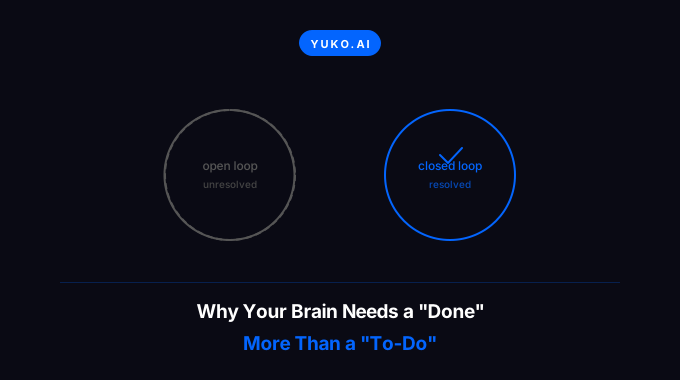
Each completed task releases Zeigarnik tension, freeing cognitive resources for the next genuinely important thing. Each meaningful completion delivers a proportional dopamine signal that reinforces the behavior of doing significant work. Each closed loop reduces the cognitive noise that makes concentration difficult and anxiety prevalent.
This is why intelligent prioritization is not just a productivity strategy. It is a cognitive hygiene practice. A person who completes three important things today is not in the same neurological state as a person who completes thirty minor ones. They have generated more meaningful dopamine signals, closed fewer but more significant loops, and left their working memory less cluttered for tomorrow.
The goal is not a longer done list. It is a better-chosen one.
Building Systems That Honor Completion
A productivity system genuinely oriented toward human neuroscience would treat completion as a primary design goal rather than a secondary outcome. It would surface the most important open loops rather than all of them, because surfacing all of them produces overwhelm rather than action. It would sequence tasks in a way that allows for genuine completion experiences rather than the permanent partial progress that characterizes most knowledge work days.
It would also recognize that the timing and framing of a nudge toward completion matters enormously. A reminder that arrives when someone is cognitively available, that connects the task to the goal it serves, and that frames completion in terms of what it will close rather than what it requires, is more likely to produce action than a bare task label in a notification tray.
The brain doesn't need more to-dos. It needs fewer, better-chosen ones — and the genuine satisfaction of finishing them.
Yuko is building the first AI nudge engine designed around how your brain actually works — surfacing the right task at the right moment, with the context that makes completion feel possible. Learn more at yuko.ai