
They got very good at capturing tasks. They never figured out how to get you to do them.
The productivity software industry has never been more sophisticated. There are apps for capturing tasks, organizing them by project, tagging them by context, filtering them by energy level, sorting them by priority, visualizing them on kanban boards, tracking them on timelines, and reviewing them in weekly rituals. There are apps that sync across every device, integrate with every calendar, and send notifications through every channel.
And yet, by every meaningful measure, the follow-through problem has not improved. Research on goal achievement rates has remained stubbornly stable for decades. The number of people who set intentions and fail to sustain them is essentially unchanged from the pre-smartphone era. The apps got better. The outcomes didn't.
This is not a coincidence. It is a design problem — a fundamental mismatch between what productivity apps were built to do and what actually produces follow-through.
The Capture Optimization Trap
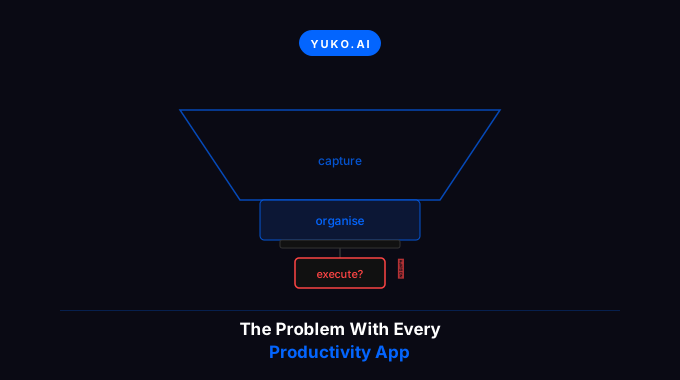
The core design assumption of virtually every productivity app built in the last decade is that the bottleneck in getting things done is capture — getting tasks out of your head and into a system reliably and quickly. This assumption traces directly to David Allen's Getting Things Done, which argued that the brain is for having ideas, not storing them, and that a trusted external system was the prerequisite for genuine productivity.
Allen was right about capture. The problem is that the industry heard "trusted system" and built increasingly sophisticated capture machines — and then stopped. Capturing a task is the easiest part of the productivity problem. It requires no motivation, no prioritization, no self-awareness about what actually matters. It just requires typing.
Notion, Todoist, Things, OmniFocus, Asana, Linear, Monday — the differences between these apps are primarily differences in capture and organization. How tasks are entered, how they're grouped, how they're displayed, how they're filtered. The harder question — how do you make sure that what gets captured actually gets done — is largely left to the user.
This is not a criticism of the engineering. Building beautiful, reliable, flexible capture systems is genuinely hard. But capture is not the bottleneck. Execution is. And optimizing for capture while leaving execution to the user is like building an extraordinarily sophisticated filing cabinet and calling it a productivity solution.
The Inbox Zero Fallacy
The canonical achievement of productivity culture is Inbox Zero — the complete processing of an email inbox to empty. Merlin Mann coined the term in 2007 and immediately tried to clarify that it was about attention management, not email management. Nobody listened to the clarification.
What Inbox Zero became in practice is a proxy metric — a visible, achievable state that feels like productivity because it is orderly and complete. The inbox is empty. The done feeling is real. The neurochemistry of completion is activated.
Whether the emails that were processed were the most important activities that could have occupied that time is not a question Inbox Zero asks. It asks only: is the inbox empty? And this is the template for how most productivity systems fail — they define success in terms of system state rather than goal state.
A fully processed task list in Notion, organized by project and tagged by context and filtered to show only today's tasks, is a beautiful system state. Whether the tasks on it are the ones that actually move the needle on anything that matters is a different question — one that the system is structurally incapable of answering, because it only knows what you told it.
The Self-Assessment Problem
Productivity apps are built on user input. You tell the app what's important. You assign the priorities. You set the due dates. You create the contexts. The app organizes and surfaces what you gave it.
This design assumption — that users are capable of accurate self-assessment about what matters most — is contradicted by several decades of behavioral research. Humans are systematically poor at prioritizing important-but-not-urgent tasks relative to urgent-but-less-important ones. We overestimate our future motivation. We underestimate task completion time. We prioritize tasks that feel achievable over tasks that feel uncertain. We systematically avoid the work that generates the most discomfort, even when that work is most aligned with our stated goals.
A productivity system that takes user self-assessment as ground truth will faithfully organize and surface a distorted picture of priorities. It will remind you, at 9am, about the tasks you told it were important yesterday — which were themselves a function of your mood, your energy level, your anxiety about specific relationships, and your desire to feel like you were making progress on something manageable.
This is not a criticism of users. It is a description of human cognition. We are all subject to the same systematic biases in self-assessment. The productivity app that takes our input uncritically and reflects it back to us is not a productivity tool. It is a sophisticated mirror showing us our own biases, organized into a list.
The Notification Volume Arms Race
There is a specific failure mode in productivity software that emerged over the last decade: the belief that more touchpoints produce more follow-through. If one reminder doesn't work, add another. If a reminder doesn't work, try a daily digest. If a digest doesn't work, add a weekly review. If a weekly review doesn't work, add an integration with Slack so the reminder finds you wherever you are.
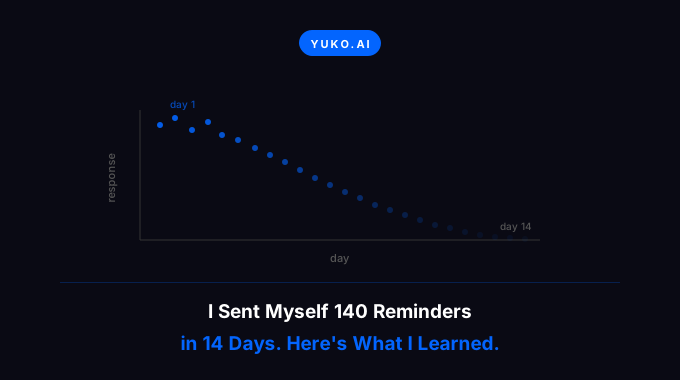
The result is a notification volume problem that has become so pervasive it has generated its own research literature. Studies on notification fatigue consistently show that beyond a certain threshold, additional notifications reduce responsiveness rather than increasing it. The brain's habituation mechanisms activate, the signals become noise, and the user either disables notifications entirely or learns to dismiss them reflexively.
Productivity apps, facing this problem, have largely responded by adding more granular notification controls — let the user decide exactly when and how they want to be reminded. This puts the burden of notification design back on the user, which returns us to the self-assessment problem. Users are no better at designing effective notification schedules for themselves than they are at prioritizing tasks accurately.
What's Missing
The gap in every productivity app built in the last decade is not a feature. It is a fundamental design orientation.
These apps were built to be trusted by users. They store what users give them and surface it faithfully. They are systems of record, organized and displayed with increasing sophistication. What they are not — what almost none of them have attempted to be — is behaviorally intelligent. They do not adapt to how a specific person actually behaves. They do not distinguish between stated priorities and revealed priorities. They do not adjust their timing and framing based on what has actually produced action versus what has been consistently ignored. They do not understand the difference between a task that needs a nudge and a task that needs a conversation.
A genuinely behaviorally intelligent productivity system would do all of these things. It would track what you actually do, not just what you planned to do. It would notice when certain types of tasks consistently slip, and treat that pattern as information rather than user error. It would vary its approach — timing, channel, framing, context — based on what has historically produced action for this specific person on this specific type of task.
It would understand that the problem was never capture. The problem has always been the distance between intention and action — and bridging that distance requires knowing something true about how a specific person behaves, not just what they told the system to remember.
The apps got very good at the easy part. The hard part is still waiting.
Yuko is building the first AI nudge engine designed to bridge the gap between intention and action — adaptive, behaviorally aware, and built around how your brain actually works. Learn more at yuko.ai