
The science behind why Duolingo's most famous feature may be undermining the very habit it's trying to build
Duolingo has over 500 million registered users. Its streak feature — a running count of consecutive days you've practiced — is one of the most discussed engagement mechanics in consumer software. It has been praised as a masterpiece of behavioral design, a gamification triumph, a model for how to build habits through technology.
It is also, according to a growing body of behavioral research, potentially counterproductive for the people who need it most.
This is not an argument that streaks are useless. They work for some people in some contexts, and Duolingo's retention numbers are real. The argument is more precise: streaks work by exploiting loss aversion, not by building intrinsic motivation — and those two things produce very different outcomes over time. Understanding the difference matters for anyone trying to build habits that last beyond the fear of a broken counter.
What Streaks Actually Measure
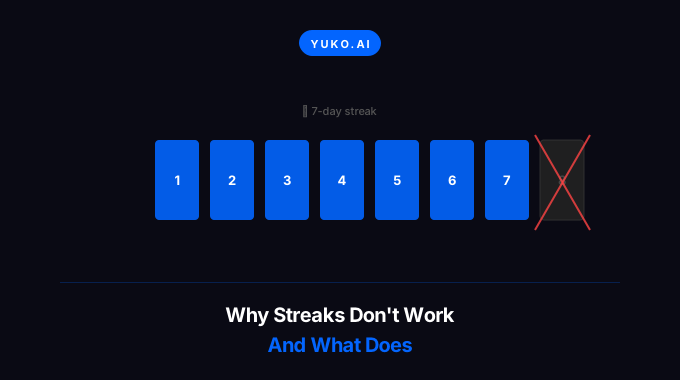
A streak measures behavioral continuity. It counts the days in a row that you performed a behavior, and it makes that count visible and meaningful by threatening to reset it to zero if you miss a day.
What a streak does not measure — cannot measure — is whether the behavior is becoming more automatic, more intrinsically rewarding, or more deeply integrated into identity. A person on a 200-day Duolingo streak might be fluent, or they might have learned to game the system with five-second lessons completed at 11:58pm to protect the number. The streak is indifferent to the difference.
This is the first problem: streaks optimize for the metric, not the goal. And when the metric diverges from the goal — when protecting the streak becomes its own motivation — the behavior it was meant to support becomes instrumental rather than intrinsic.
Loss Aversion Is a Powerful but Unstable Foundation
The mechanism behind streak anxiety is well understood. Behavioral economists Daniel Kahneman and Amos Tversky established that losses feel roughly twice as painful as equivalent gains feel pleasurable. A broken streak triggers loss aversion — the prospect of losing something you've accumulated — rather than the anticipation of gaining something you want.
This is effective for short-term engagement. Loss aversion is one of the strongest motivators available. The problem is that it is inherently fragile as a foundation for long-term behavior change.
Research on motivation consistently distinguishes between controlled motivation — doing something to avoid a negative consequence — and autonomous motivation — doing something because it aligns with your values or is genuinely enjoyable. Controlled motivation produces behavior, but it requires constant external pressure. Autonomous motivation produces behavior that persists even when the external system is absent.
Streaks are a controlled motivation mechanism. They produce behavior because missing feels bad, not because practicing feels good or meaningful. And when the streak breaks — as it inevitably does for most users, through illness, travel, or simple exhaustion — the loss aversion that drove the behavior evaporates with it. There is nothing underneath to sustain the habit, because the habit was never really built. The streak was.
The Overjustification Effect
There is a more subtle problem with extrinsic reward systems like streaks, one that Duolingo's designers are certainly aware of: the overjustification effect.
In a now-classic 1973 study, researchers Mark Lepper, David Greene, and Richard Nisbett gave children who already enjoyed drawing a "Good Player Award" for drawing. When the reward was later removed, the children drew less than children who had never received a reward at all. The external reward had crowded out the intrinsic motivation that existed before.
This finding has been replicated across many contexts. When people are given external rewards for behaviors they were already intrinsically motivated to pursue, the rewards often reduce intrinsic motivation — particularly when the rewards are contingent on performance or visible to others.
Applied to language learning: a person who begins Duolingo with genuine curiosity about Spanish, and who is then trained for months to protect their streak, may end their streak relationship with less intrinsic motivation to learn than they started with. The streak didn't enhance their love of learning. It replaced it.
What Happens When the Streak Breaks
The streak-break moment is where the design reveals its deepest flaw. Most streak systems treat a missed day as a catastrophic reset — all progress gone, counter back to zero, start over. This framing is psychologically brutal and behaviorally counterproductive.
Research on what psychologists call the "what-the-hell effect" — first documented in studies of dieting by Janet Polivy and C. Peter Herman — shows that when people who are trying to maintain a behavioral standard violate it, they often respond not by returning to baseline but by abandoning the standard entirely. "I already broke my diet today, so I might as well eat everything." "I already broke my streak, so I might as well stop for the month."
The binary nature of a streak — you either maintained it or you didn't — makes this effect almost inevitable. A person who misses day 47 of a 46-day streak doesn't feel like they've taken a small step backward. They feel like they've lost everything. And for many, that feeling is the end of the behavior entirely.
A habit-building system that produces this outcome for its most vulnerable users — the ones who most need sustained support to build new patterns — is not well designed for the goal it claims to serve.
What Actually Builds Lasting Habits
The research on durable habit formation points in a different direction from streak mechanics. The key variables that predict whether a behavior will become automatic are not continuity metrics — they are repetition in context, intrinsic reward, and identity integration.
Repetition in context matters more than unbroken continuity. A behavior performed in the same context — same time, same place, same preceding activity — becomes linked to those contextual cues through a process called context-dependent learning. The context eventually triggers the behavior automatically, without deliberate motivation. A missed day doesn't break this association; it simply delays its consolidation. Recovery is fast. The habit isn't fragile.
Intrinsic reward — the genuine pleasure or meaning derived from the behavior itself — is the strongest predictor of long-term persistence. This can be cultivated by emphasizing progress over performance, connecting behavior to identity ("I am someone who learns languages") rather than outcomes ("I want to speak Spanish"), and designing for genuine satisfaction rather than anxiety avoidance.
Identity integration — the degree to which a behavior is connected to who you believe yourself to be — is perhaps the most powerful factor of all. Research by Wendy Wood and David Neal on habit formation consistently finds that habits tied to self-concept are the most robust against disruption. You don't need to protect a streak to maintain a behavior that feels like an expression of who you are.
The Alternative Design
A system genuinely oriented toward habit building would look different from a streak counter. It would track behavioral patterns rather than continuity — noticing when a habit is becoming more automatic, when it's being performed in stable context, when the underlying motivation appears intrinsic versus controlled. It would treat missed days as data rather than failure, using them to understand what conditions support or undermine behavior rather than simply resetting the count.
It would connect each instance of a behavior to the reason behind it — the goal it serves, the identity it expresses, the value it reflects — rather than to a number. And it would deliver variable, contextually resonant encouragement rather than the flat, predictable "you're on a streak" notification that the brain learns to tune out in three days.
Think of the difference between a coach who knows why you care about what you're doing and adjusts their guidance accordingly, and a scoreboard that goes blank the moment you miss a session. One builds something. The other just keeps count.
The Honest Assessment
Streaks work. In the narrow sense of producing daily engagement, for users who respond well to loss aversion mechanics, in the short to medium term, they are effective. Duolingo's data is not fabricated.
But "works" is not the same as "works best" or "works for the goal it claims to serve." A system that produces behavior through fear of loss, that potentially undermines intrinsic motivation over time, and that catastrophizes the inevitable missed day into a full behavioral reset is not a habit-building system. It is an engagement system dressed in habit-building language.
The distinction matters because habits and engagement are different goals with different optimal designs. An app optimized for daily active users is not automatically optimized for whether those users actually build the skill or behavior they came for. And when those two objectives diverge — when protecting the metric requires compromising the outcome — the outcome tends to lose.
Building habits that last requires working with the brain's natural learning systems, not around them. It requires intrinsic motivation, contextual repetition, and identity connection. The streak counter, for all its elegance, is a workaround for the harder problem of genuine motivation. And workarounds have a way of holding only until they don't.
Yuko is building the first AI nudge engine designed around how your brain actually works — variable, contextual, and anchored to the why behind your goals. Learn more at yuko.ai