
An honest audit of Getting Things Done in the age of AI
David Allen published Getting Things Done in 2001. In the quarter-century since, it has sold millions of copies, spawned an entire cottage industry of apps and accessories and community forums, and become something close to the canonical framework for knowledge worker productivity. Its influence is so pervasive that people who have never read the book have absorbed its core ideas through osmosis — the inbox, the capture habit, the weekly review, the trusted system.
GTD deserves the respect it has received. Allen identified real problems with real clarity, and some of his core insights remain as sharp today as they were in 2001. But GTD is also a product of its moment — written before smartphones, before the attention economy, before AI, before the notification environment that now shapes every knowledge worker's day. Applying it uncritically in 2026 means inheriting assumptions that no longer hold.
This is an honest assessment of what Allen got right, what the system gets wrong, and what it simply couldn't have anticipated.
What Allen Got Right
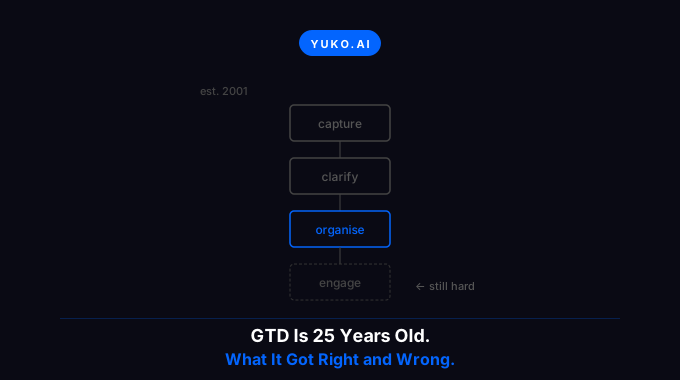
The foundational insight of GTD is still correct: the brain is not a reliable storage device for commitments, and trying to use it as one generates cognitive load that undermines performance. Allen's injunction to capture everything into a trusted external system wasn't novel in 2001 — the concept of externalizing memory has a long history — but he articulated it with unusual clarity and built a practical system around it.
The research has consistently supported this. The Zeigarnik effect — the cognitive tension generated by incomplete tasks — is real, and one of its most reliable antidotes is capturing a task into a system you trust to surface it at the right time. When the brain believes that a task will be remembered without its help, it releases the task from active working memory. The mental clutter that comes from trying to remember everything genuinely does reduce when you capture consistently.
Allen was also right about the importance of clarifying actions. The distinction between a project ("launch new website") and a next action ("draft homepage copy") is psychologically significant. Projects don't get done; next actions do. The ambiguity of a project-level entry on a task list generates a specific kind of paralysis — the brain can't find a clear starting point, so it defers. Clarifying the immediate next physical action removes that ambiguity and reduces activation energy.
These two insights — capture everything, clarify to next actions — are GTD's most durable contributions. They were right in 2001 and remain right today.
What GTD Gets Wrong
The system's weaknesses emerge clearly from the perspective of behavioral science, much of which was still developing when Allen wrote the book.
The trusted system assumption. GTD works if and only if you genuinely trust your system to surface the right things at the right times. For many people, that trust never fully develops — because the system surfaces everything, not the right things. A GTD implementation that faithfully captures 200 tasks across 15 projects and surfaces them through a weekly review is technically correct and practically overwhelming. The trusted system becomes a trusted archive that nobody actually reads.
The self-assessment problem. GTD relies heavily on the user's ability to accurately assess priority and context during the weekly review. Research on cognitive biases in task selection — urgency bias, completion bias, effort aversion — suggests that this self-assessment is systematically distorted in predictable ways. A person doing a weekly review is not making fully rational prioritization decisions. They are making decisions shaped by their current mood, energy level, and anxiety about specific tasks. GTD offers no corrective for this.
The motivation assumption. GTD is largely silent on motivation. It assumes that if a system is well-organized and trusted, the user will execute on it. This assumption is belied by the experience of the majority of serious GTD practitioners, who find that the system works beautifully for capturing and organizing but does relatively little to help them actually do the work they've captured. Motivation is not a system design problem that GTD addresses, because Allen largely didn't see motivation as the failure point.
The static priority model. GTD's context and priority model was designed for a world of discrete, predictable tasks. The knowledge worker's world in 2026 is significantly more fluid — priorities shift mid-week based on new information, projects intersect in non-obvious ways, and the most important work is often the most ambiguous. A system that categorizes tasks at capture time and resurfaces them at review time has no mechanism for dynamically recalibrating based on how the world has changed in between.
What Allen Couldn't Have Predicted
Allen wrote GTD before the smartphone. The implications are significant.
The notification environment. GTD was designed for a world of relatively infrequent interruptions — email that arrived in batches, phone calls that required deliberate answer, letters that took days. The system's advice to process your inbox to zero and conduct a weekly review assumed an inbox that was manageable in volume and asynchronous in character. In 2026, the average knowledge worker receives hundreds of notifications per day across multiple channels. GTD has no answer for this because the problem didn't exist at the scale it now does.
The attention economy. Since 2001, the business model of software has largely shifted toward maximizing user engagement — keeping people in apps through algorithmic feeds, infinite scroll, variable reward mechanics, and notification systems designed by behavioral scientists whose job is to make the app as difficult to ignore as possible. GTD was written before this environment existed. It has no framework for helping users maintain focus and intentionality in a world where dozens of corporations are competing for their attention using tools considerably more sophisticated than a task list.
The AI layer. This is the most consequential thing Allen couldn't have anticipated: that it would eventually be possible to build a system that learns how a specific person actually behaves — not how they say they prioritize, but what they actually do — and uses that knowledge to surface tasks, adjust timing, vary framing, and bridge the gap between the trusted system and genuine execution.
GTD's trusted system is passive. It stores and reflects. An AI-powered system can be active — it can notice that you consistently defer tasks of a certain type on Monday mornings, and adjust accordingly. It can observe that certain framings produce action while others don't, and adapt. It can maintain the motivational reality of a goal — not just its task label — through contextually relevant nudges at behaviorally informed moments.
This is the evolution that GTD's architecture couldn't anticipate: not a better capture system, but an intelligent bridge between capture and completion.
GTD in 2026: A Practical Assessment
If you are a GTD practitioner, the system's capture and clarification practices are still worth maintaining. The habit of getting things out of your head and into a trusted system, and of clarifying to next actions, reduces cognitive load in ways that are well-supported by the research.
Where the system needs augmentation is in the execution layer. The weekly review is not sufficient for dynamic prioritization in a fast-moving environment. Self-assessment is too biased to be relied upon for important prioritization decisions. And motivation — the actual fuel of follow-through — requires more than a well-organized list to remain alive.
The GTD practitioner of 2026 who wants the system to actually work needs to pair it with something the book doesn't provide: a behaviorally intelligent execution layer that understands the difference between what was captured and what will actually get done — and actively works to close that gap.
Allen built the foundation. The building still needs the rest of its floors.
Yuko is building the AI nudge layer that GTD was always missing — behaviorally aware, adaptive, and designed to bridge the gap between a trusted system and genuine follow-through. Learn more at yuko.ai