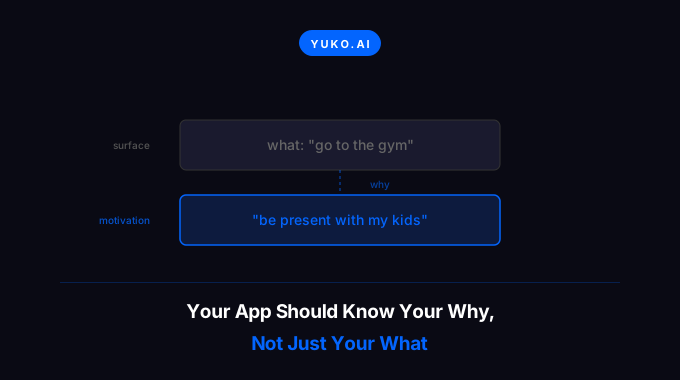

Every productivity app asks you the same question when you create a task or set a reminder. What do you want to do? Exercise. Call mom. Finish the report. Learn Spanish. The what gets captured, timestamped, and filed. The app is ready to remind you.
What almost no app ever asks is the question that actually determines whether you will follow through: why does this matter to you?
This omission is not incidental. It reflects a fundamental misunderstanding of what drives human behavior — one that is built so deeply into the architecture of most productivity tools that it shapes every interaction from the first tap. And it is, more than any technical shortcoming, the reason so many of these apps feel useful for a week and irrelevant by the second month.
The Task Is Not the Point
When someone sets a reminder to exercise three times a week, the task — go to the gym, run, do something physical — is almost never the actual goal. Behind the task is an intention. Maybe it is to have more energy for their kids. Maybe it is to manage anxiety without medication. Maybe it is to feel capable in their body again after a period of illness or inactivity. Maybe it is simply to become someone who follows through on commitments, and exercise is the chosen arena for practicing that.
The task is a vehicle. The why is the destination. And the why is where motivation actually lives.
Behavioral research has been consistent on this point for decades. Self-determination theory, developed by Edward Deci and Richard Ryan, distinguishes between intrinsic motivation — doing something because it connects to your own values and sense of self — and extrinsic motivation, doing something because of external pressure or reward. Intrinsically motivated behavior is dramatically more persistent, more resilient to setbacks, and more likely to become genuinely habitual. Extrinsically motivated behavior is fragile and disappears when the external prompt does.
A reminder that says "Time to work out" is an external prompt. It is asking you to respond to the app's schedule, not to your own reasons. It is optimizing for compliance, not for the kind of motivated engagement that produces lasting change.
What Gets Lost in Translation
The process of entering a goal into most apps strips it of almost everything that made it meaningful. You had a moment of genuine intention — sparked by a conversation, a health scare, a birthday, a quiet moment of reflection about who you want to be. You felt something. The goal had texture and weight and personal significance.
Then you opened the app, typed a few words, picked a time, and the whole living thing got reduced to a label on a schedule. "Exercise. 7am. Daily."
That label is not your goal. It is a pointer to your goal. And a pointer without the thing it points to is just noise.
This is why reminders that were set with genuine intention can feel, weeks later, like they belong to a different person. In a sense they do. The context that made the goal feel urgent and meaningful has faded. The reminder surfaces the what without any of the why, and the why was doing all the motivational work.
The Why Has a Short Half-Life Without Renewal
Goals do not maintain their psychological force automatically. The research on motivational persistence shows that the felt sense of why something matters requires regular renewal — not just memory, but active re-engagement with the original intention.
This is one reason that practices like journaling, therapy, and coaching retain value over time even for people who have a clear intellectual understanding of their goals. The understanding is not enough. The connection to the why needs to be felt, rehearsed, and occasionally re-examined as life changes and priorities shift.
An app that only stores and surfaces the what is leaving this entire dimension of motivation untouched. It is delivering the address without the reason for the trip.
A system designed around the why would work differently. It would capture not just what you want to do, but why it matters to you — and it would use that understanding to shape every subsequent interaction. A nudge connected to your actual reason for setting a goal lands differently than one that simply restates the task. "You wanted to run because you want to be present with your kids without being out of breath" is not the same prompt as "Time to run." One re-engages you with your own motivation. The other asks you to comply with a schedule.
Knowing the Why Changes Everything About the Nudge
When a system understands the why behind a goal, the entire character of its interventions can change. Instead of issuing directives, it can ask questions that reconnect you to your original intention. Instead of tracking completion, it can track meaning — whether the goal still reflects what you care about, whether the why has shifted, whether a different approach to the same underlying intention might serve you better.
It can recognize that a goal abandoned is not always a failure. Sometimes the why behind a goal changes, and the goal itself becomes obsolete. A system that knows your why can help you tell the difference between avoidance and genuine re-prioritization. Between a goal you are running from and one you have genuinely moved past.
It can also adapt its framing over time. If the why behind your fitness goal is energy for your kids, a nudge on a morning after a difficult night with a sick child lands differently than it does on a fresh Tuesday. A system that knows what actually matters to you can be contextually intelligent in ways that a scheduler simply cannot.
The Harder Question Is Worth Asking
None of this is technically simple. Capturing the why requires more from the user at setup — more reflection, more articulation, more vulnerability than typing a task name and picking a time. And it requires more from the system — genuine understanding of how stated intentions connect to behavior, how to use that understanding to shape nudges that feel relevant rather than generic.
But the alternative is the status quo: apps that know what you said you would do, remind you that you have not done it, and gradually become one more source of low-grade guilt in a life that probably already has enough of it.
The what without the why is a task. The why without the what is a dream. The tools worth building are the ones that hold both, and use the connection between them to keep motivation alive long after the initial intention has faded.
Your app should know what you want to do. But more than that, it should know why you wanted to do it in the first place — and remind you of that person, and that moment, when it matters most.
This article is part of a series. Read the full argument in We've Been Building Reminder Apps Wrong.
Yuko is an anti-habituation nudge engine built to keep your goals psychologically alive. Learn more at yuko.ai.