
Why intention and action live in different parts of your brain — and what that means for anyone trying to build a habit
At some point in the last year, you made a decision you meant. Not a casual preference — a genuine commitment. You were going to exercise consistently, finish the book, call more often, learn the thing, ship the project. The intention was real. The follow-through wasn't.
This is the experience that productivity culture tends to explain with character. Discipline, grit, motivation, willpower — the language implies that people who follow through have something that people who don't are lacking. What the neuroscience actually shows is more interesting, and considerably more forgiving: intention and action are not the same mental process. They are not even handled by the same brain systems. And understanding that gap is the first step toward closing it.
Two Systems, One Goal
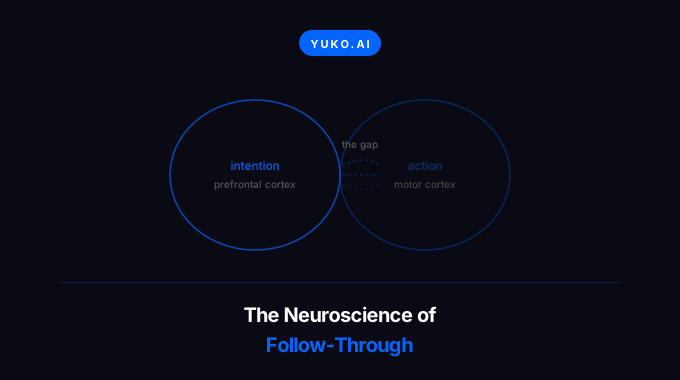
The prefrontal cortex is the seat of human planning. It sits at the front of the brain, behind the forehead, and it is where goals live — where future states are imagined, where commitments are formed, where the decision to change something about your life actually happens. When you resolve to exercise every morning, that resolution is encoded in the prefrontal cortex. It feels solid because, in that moment, it is. The prefrontal cortex is genuinely committed.
The problem is that behavior is not executed by the prefrontal cortex. Day-to-day actions — the routine ones, the ones that require no conscious deliberation — are managed primarily by the basal ganglia, a cluster of structures deep in the brain that specializes in habit formation, procedural memory, and automatic behavior. The basal ganglia doesn't care about your plans. It responds to cues, executes routines, and delivers rewards. It is a system built for efficiency, not aspiration.
When the alarm goes off at 6am and you decide to stay in bed instead of going to the gym, you are not failing your prefrontal commitment. You are experiencing a jurisdiction dispute between two brain systems that evolved for different purposes. The prefrontal cortex made the plan; the basal ganglia is running the morning.
This is not an excuse. It is a map.
The Prospective Memory Problem
There is a specific kind of memory that governs follow-through, and it is different from the memories we typically talk about. Psychologists call it prospective memory — the ability to remember to do something in the future. It is distinct from retrospective memory (remembering what happened) and working memory (holding information in mind right now).
Prospective memory is surprisingly fragile. Research by Gollwitzer and Brandstätter in the 1990s — and extensively replicated since — found that simply forming an intention is a poor predictor of whether a behavior will occur. The strength of the motivation matters less than the specificity of the implementation plan. People who formed what the researchers called "implementation intentions" — explicit if-then plans linking a specific situation to a specific action — were significantly more likely to follow through than those who simply resolved to do something.
The mechanism is straightforward. An implementation intention ("When I finish breakfast, I will put on my running shoes") creates a prospective memory cue that is tied to a situational trigger rather than requiring active recall. The behavior gets pre-loaded onto an environmental condition rather than depending on the prefrontal cortex to generate it from scratch each morning.
This is why "try harder" is bad advice. The problem isn't motivational strength. It's the architecture of how intentions are stored and retrieved.
Why Motivation Decays
Even well-formed intentions erode. The experience is universal — the resolution that feels unshakeable in January has become a vague aspiration by March. This isn't weakness. It's neurochemistry.
When you form a new intention, particularly one tied to a compelling future vision, the brain releases a modest burst of dopamine. This is the neurochemical associated with anticipation and reward — the feeling of possibility. It's the same system that activates when you look forward to a vacation, read an exciting book, or imagine achieving something significant. It feels motivating because, in a literal chemical sense, it is.
The problem is that dopamine release in response to anticipated rewards habituates. The brain models the expected reward, and over time, the mere thought of the goal stops generating novelty — and therefore stops generating the dopamine that made the intention feel vital. The goal hasn't changed. Your neurochemical response to it has.
This is why people often feel more motivated at the start of a new project than at any subsequent point, and why returning to an abandoned goal often requires reframing it — approaching it from a different angle, attaching it to new stakes, or connecting it to a reason that wasn't salient before. The brain needs a fresh signal, not a repeated one.
The Role of the Anterior Cingulate Cortex
Between intention and action sits a neural structure that doesn't get enough attention in popular discussions of productivity: the anterior cingulate cortex, or ACC. This region sits at the junction between the prefrontal cortex and the limbic system, and it functions roughly as a conflict monitor — detecting mismatches between intended and actual behavior, and generating the discomfort that motivates correction.
The ACC is why you feel guilty when you skip the gym, or vaguely uneasy when you haven't made progress on something you care about. That discomfort is not irrational. It is the brain's self-monitoring system doing exactly what it evolved to do: flagging divergence between who you intend to be and what you are currently doing.
The implication is significant. Follow-through isn't purely a matter of willpower or motivation. It depends on the ACC maintaining a live, active comparison between intention and behavior. When that comparison is fresh — when the goal is psychologically present, not just stored somewhere — the corrective signal is strong. When the goal has faded into background intention, the ACC has nothing to compare against. The alarm is off. The drift goes unnoticed.
This is why keeping the "why" alive matters more than tracking the "what." A task on a list is inert. A goal that is emotionally and cognitively present generates the ACC signal that nudges behavior back toward intention. The most effective follow-through systems are the ones that keep that signal active — not through guilt or pressure, but through regular, contextually rich reconnection with the underlying motivation.
What the Research Says About Effective Cues
The behavioral science on habit formation converges on a few consistent findings. Charles Duhigg's synthesis of the habit loop literature — cue, routine, reward — is accurate as far as it goes, but the nuances matter. Not all cues are equally effective. Not all rewards maintain their potency over time.
The most durable behavioral cues share several properties. They are contextually specific — tied to a particular situation rather than a time of day. They are emotionally charged — connected to a reason that matters, not just a task that exists. And they are variable enough to avoid habituation — arriving in a form the brain hasn't already learned to filter.
On the reward side, variable rewards consistently outperform fixed rewards in maintaining behavioral engagement. This is Skinner's variable ratio reinforcement finding, extended into everyday behavior: the brain stays more alert and responsive to rewards it cannot fully predict. A streak counter delivers a fixed, predictable reward. A genuinely surprising, contextually resonant piece of positive feedback does something neurologically different — it re-engages the dopamine system in a way that predictable rewards cannot.
The practical upshot is that the systems most likely to support follow-through are the ones that treat goals as living commitments rather than stored tasks — reconnecting people to their intentions in ways that are fresh, specific, and emotionally grounded.
Closing the Gap
The gap between intention and action is not a character flaw. It is a structural feature of how human cognition works — a gap between the prefrontal planning system and the basal ganglia execution system, bridged imperfectly by prospective memory and regulated by the ACC's self-monitoring function.
Closing that gap reliably requires working with these systems rather than against them. It means creating cues that are specific and contextual, not generic and time-based. It means keeping the emotional reality of the goal present, not just its task-label. It means building in variability to avoid the habituation that makes any repeated stimulus invisible. And it means designing for the ACC's need to maintain a live comparison between intention and behavior — which requires that the intention itself remains vivid.
None of this is complicated in principle. All of it is ignored by the standard reminder app, which treats a goal as a record in a database and a reminder as a scheduled notification.
The distance between who you intend to be and who you are is not the measure of your motivation. It is the measure of your tools.
Yuko is building the first AI nudge engine designed around how your brain actually works — keeping intentions alive, cues variable, and follow-through consistent. Learn more at yuko.ai