
A thought experiment, a cognitive bias, and a framework for reclaiming your time
Here is a thought experiment worth sitting with.
Imagine two versions of your professional life over the next five years. In the first version, you spend those five years doing exclusively urgent things. You respond to every email promptly. You attend every meeting requested of you. You handle every crisis as it arrives. You are reliably reactive and consistently available. Your inbox is managed. Your Slack response time is excellent. You never miss a deadline because you are always, always attending to what is immediately pressing.
In the second version, you spend five years doing exclusively important things. You work on the skills your field will reward in a decade. You build the relationships that will open the doors that don't yet exist. You develop the ideas that take months to ripen. You create the body of work that compounds. You make the health investments that pay off slowly and then all at once. You do the things that have no deadline because their deadline is your entire life.
At the end of five years, which version of you would you rather be?
Almost everyone answers the same way. And almost everyone spends their actual days much closer to version one.
The Architecture of a Wasted Day
The research on how knowledge workers actually spend their time is consistent enough to be uncomfortable. Studies of email behavior find that the average knowledge worker spends between two and four hours per day on email — not because email is strategically important but because it is urgent, accessible, and offers the immediate dopamine reward of completion. Studies of meeting culture find that middle managers spend between 35% and 50% of their time in meetings, the majority of which they rate as unproductive or unnecessary.
These are not rounding errors. This is the majority of a working life going to things that feel urgent rather than things that are important.
Parkinson's Law — the observation that work expands to fill the time available — explains part of the dynamic. When urgent tasks are available in unlimited supply, and important work has no fixed deadline, the urgent work will fill every hour that isn't explicitly protected. Urgency is a force; importance is a consideration. In the competition between force and consideration, force wins by default.
What makes this particularly pernicious is that urgent work tends to feel productive. You're responding, attending, handling, resolving. The inbox is moving. The meeting ended with clear action items. Something happened. The brain's completion-reward system fires, and the day feels like progress because it was full.
The question of whether that fullness moved anything that actually matters — whether the five-year version of you is meaningfully different from what it would have been — is a question that urgent work never asks and busy days never answer.
How Notifications Weaponize Urgency
The attention economy has made the urgency bias significantly worse, and deliberately so.
The notification systems of modern software were not designed to help you manage your priorities. They were designed to maximize engagement with the products sending them — which means maximizing urgency signals, because urgency signals produce immediate behavior. A notification that arrives with a red badge and an unread count is leveraging the exact same loss aversion and urgency detection that evolved to help our ancestors respond to immediate threats.
The result is an environment that generates artificial urgency at scale. Not every email is urgent. Not every Slack message warrants immediate attention. Not every notification reflects a genuinely time-sensitive situation. But they all arrive with the same visual and auditory grammar of urgency — the badge, the buzz, the sound — and the brain responds to that grammar more reliably than it responds to the actual importance of the content.
This is the mechanism by which the attention economy colonizes important time. It doesn't steal the time directly. It manufactures enough artificial urgency to fill every gap, so that the important work — which waits quietly, generating no notifications, making no demands — is perpetually displaced.
A person who allows their attention to be fully managed by notification systems is not making choices about their time. They are having their time chosen for them, by algorithms optimized for engagement, not for the outcomes that actually matter in their lives.
The Planning Fallacy and Why Tomorrow Never Comes
One of the most reliable findings in behavioral economics is the planning fallacy — the tendency to underestimate how long tasks will take and to overestimate future motivation and availability.
Applied to important work, the planning fallacy produces a specific pattern: consistently deferring Q2 tasks to a future that appears more spacious than the present. "I'll work on the strategy document next week when things calm down." Things do not calm down. They never calm down. Next week looks exactly like this week — full of urgent demands, short of protected time, short of the focus that the important work actually requires.
The planning fallacy interacts with present bias to create an almost perfect deferral machine. Present bias makes today's urgency feel more compelling than tomorrow's importance. The planning fallacy makes tomorrow's availability seem more generous than it will actually be. The result is a systematic pattern of choosing urgent today over important tomorrow, every day, indefinitely.
Research on this pattern by Piers Steel, the author of the comprehensive meta-analysis on procrastination, finds that task aversiveness — the degree to which a task is uncomfortable, ambiguous, or anxiety-provoking — is the strongest predictor of chronic deferral. Important tasks tend to be aversive precisely because they are important: they are complex, they involve uncertainty, they carry real stakes. The discomfort of doing them is real and present. The benefit is diffuse and future.
This is why the advice to "just prioritize what matters" is insufficient. The bias toward urgency and away from aversive-but-important tasks is not corrected by awareness alone. It requires ongoing behavioral support — environmental design, commitment devices, and timely nudges that make the important feel as immediate as the urgent.
An Audit Worth Doing
Before any framework or system can help, there is a diagnostic step that most productivity advice skips: looking honestly at where your time actually went last week, not where you intended it to go.
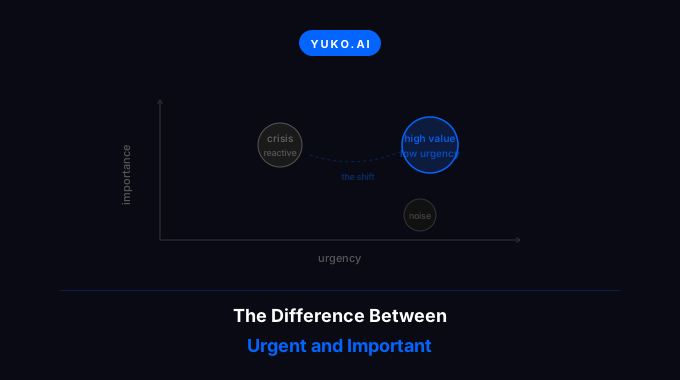
Take last week's calendar and categorize every significant time block along two dimensions: how urgent was it, and how important was it? Separate your own judgment of importance from the urgency signal the task arrived with. Email from your CEO feels urgent and important; is it? The meeting you were invited to felt obligatory; was it actually important to your core goals?
Most people who do this exercise honestly find a significant gap between their stated priorities and their actual allocation. The gap is not random. It follows the predictable pattern of urgency bias, completion bias, and aversion to difficult Q2 work. Seeing the pattern clearly is not sufficient to change it — but it is necessary.
The five-year version of yourself that you prefer is not built by accident. It is built deliberately, in the gaps between urgent demands, by people who have found ways to make important work feel as pressing as the urgent work competing for their attention.
Those ways exist. They are not mystical. They are behavioral and environmental — a function of how your surroundings, your cues, and your support systems are designed. The urgent demands will always be there. The important work will always wait. The difference between the two versions of your life is what you do with that fact.
Yuko is building the first AI nudge engine that actively fights urgency bias — surfacing what matters most at the moments when urgent demands threaten to crowd it out. Learn more at yuko.ai