
In the 1950s, the behavioral psychologist B.F. Skinner discovered something that would go on to shape the design of nearly every attention-capturing system built in the decades that followed. He was studying how rats learned to press levers for food pellets, and he began experimenting with different schedules of reward. What he found confounded the intuitive assumption that consistent, reliable rewards would produce the strongest behavior.
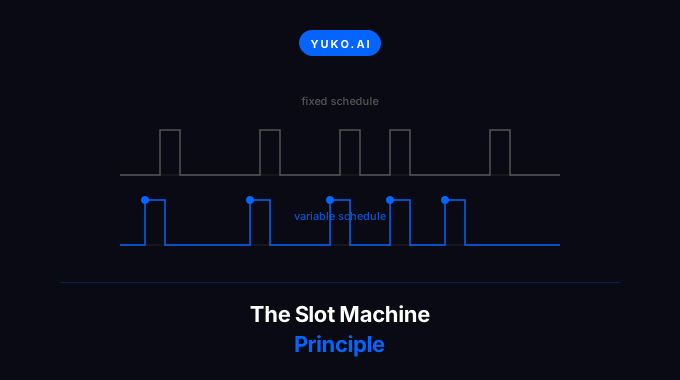
They did not. The schedule that produced the most persistent, most resistant-to-extinction behavior was one where rewards arrived unpredictably — sometimes after one lever press, sometimes after ten, with no pattern the rat could learn or anticipate. Skinner called this a variable ratio reinforcement schedule, and its effects on behavior were striking enough that they have been replicated across species, contexts, and decades of research ever since.
The slot machine was not designed by accident. It was designed around this exact principle. And the lesson it contains for anyone building tools meant to sustain human motivation is more important, and more underused, than almost anything else in behavioral science.
Why Predictability Is the Enemy of Engagement
To understand why variable rewards produce stronger engagement than fixed ones, it helps to think about what predictability does to the brain. When a pattern is fully learned — when the brain knows exactly when a reward or stimulus will arrive — it optimizes around that pattern. Anticipatory responses ramp up just before the expected moment and taper off immediately after. The period between expected rewards is essentially written off. The brain has learned it does not need to pay attention.
This is efficient. It is also, from the perspective of sustained engagement, catastrophic. A reminder that fires every day at 8am is a fully predictable pattern. Within days, the brain has modeled it. It knows the reminder is coming. It allocates minimal resources to processing it. The reminder arrives, gets cleared, and leaves no trace.
The variable ratio schedule disrupts this entirely. Because there is no learnable pattern — because the next occurrence could be now, or in an hour, or tomorrow — the brain cannot optimize around it. It has to stay alert. The orienting response, the neurological machinery that directs attention toward potentially meaningful stimuli, cannot be switched off between occurrences because there is no way to know when the next one will come.
This is not a trick. It is the brain's genuine, evolved response to uncertain reward environments. In the natural world, food, danger, and opportunity all arrived unpredictably. The brain that stayed alert to uncertain signals survived. The one that habituated to them did not.
What This Means for Reminders
Applied to nudges and reminders, the slot machine principle yields a clear prescription: variability in timing, variability in framing, and variability in the nature of the prompt itself all contribute to sustained engagement in ways that fixed schedules cannot replicate.
A nudge that arrives at an unexpected time of day carries more weight than one that arrives on schedule. Not because the content is different, but because the brain's pattern-detection system has not pre-classified it as ignorable. The orienting response fires. Attention is genuinely allocated. There is a moment of real engagement rather than reflexive dismissal.
Add variability in the message itself — different framings of the same goal, different questions, different angles on the same intention — and the effect compounds. The brain cannot habituate to a stimulus it cannot fully predict. Each encounter requires a small amount of genuine processing. And genuine processing is where behavior change actually happens.
This is the difference between a system that reminds and a system that re-engages. The reminder is a fixed signal. The re-engagement is a variable one. The first habituates. The second does not.
The Ethics of Unpredictability
It is worth pausing here, because the slot machine analogy raises a legitimate concern. Variable ratio schedules are also the mechanism behind compulsive gambling, social media scroll behavior, and a range of digital products that have been credibly accused of exploiting psychological vulnerabilities for engagement metrics. If unpredictability is this powerful, is it ethical to build around it?
The answer depends entirely on what the unpredictability is in service of. A slot machine uses variable rewards to keep someone gambling against their own interests. A social media feed uses variable content to keep someone scrolling past the point of enjoyment or benefit. The variability is deployed to maximize time in the product, regardless of whether that time serves the user.
The same principle applied to genuine goal pursuit works differently. Unpredictable nudges toward things the user has chosen, for reasons they have articulated, in service of a life they are trying to build — this is variability deployed in the user's interest, not against it. The goal of the system is not to maximize engagement with the app. It is to maximize follow-through on the user's own intentions. The user's interest and the system's behavior are aligned.
The mechanism is the same. The purpose is opposite.
Building for the Variable Ratio
What does a reminder system actually look like when it is designed around variability rather than fixed schedules? Several things change.
Timing becomes dynamic rather than static. Instead of firing at the same time every day, the system learns when a user is most receptive — and introduces enough variation around that window to prevent full habituation. Some nudges arrive early, some late, some at genuinely unexpected moments.
Framing rotates. The same goal is approached from different angles on different days. Some nudges connect to the emotional why behind the goal. Some reframe progress. Some ask a question rather than issuing a prompt. The unpredictability of form reinforces the unpredictability of timing.
Frequency varies with context. Some weeks call for more nudges, some for fewer. The system reads signals about where the user is in their relationship with a goal and adjusts accordingly, rather than maintaining a fixed cadence regardless of whether it is helping.
None of this is easy to build. It requires understanding goals at a level of depth that a simple scheduler never needs. It requires learning from user behavior over time. It requires treating the reminder as a dynamic intervention rather than a static broadcast.
But it is the only architecture that does not eventually train its users to ignore it.
The Lesson Skinner's Rats Have for Productivity
The rats pressing levers in Skinner's lab were not weak-willed. They were not failing to follow through. They were responding exactly as evolution had shaped them to respond — with sustained attention toward uncertain, potentially rewarding signals, and learned indifference toward predictable ones.
We are the same. Our brains run on the same basic architecture, refined over millions of years to stay alert to unpredictability and filter out repetition. Every fixed-schedule reminder app is fighting that architecture. Every variable, contextually aware nudge system is working with it.
The slot machine figured this out decades ago. It is past time for the tools trying to help us become better versions of ourselves to learn the same lesson.
This article is part of a series. Read the full argument in We've Been Building Reminder Apps Wrong.
Yuko is an anti-habituation nudge engine built to keep your goals psychologically alive. Learn more at yuko.ai.