
And the neuroscience that explains why more reminders make it worse.
You set a reminder. Your phone buzzes at 2pm. You glance at it, think “right, I need to do that,” and keep scrolling. Three days later you find it sitting in your notification tray, unread, next to seventeen others exactly like it.
This isn’t a discipline problem. It’s not a motivation problem. It’s a neuroscience problem — and the app that sent you that reminder almost certainly made it worse.
Your brain has a filter. You trained it to block you out.
The human brain processes roughly 11 million bits of information per second. It consciously handles about 50.
To manage that gap, your nervous system runs a continuous triage operation. Stimuli that are novel, unpredictable, or emotionally significant get escalated. Stimuli that are familiar, predictable, or repetitive get suppressed — often before they reach conscious awareness at all.
This suppression mechanism has a name: habituation. And it is one of the most fundamental, well-documented phenomena in all of neuroscience.
The classic research dates to Soviet physiologist Evgeny Sokolov, who in the 1960s identified what he called the orienting response — the brain’s automatic “what is that?” reaction to novel stimuli. Heart rate shifts. Pupils dilate. Attention locks on. It’s the biological version of a double-take.
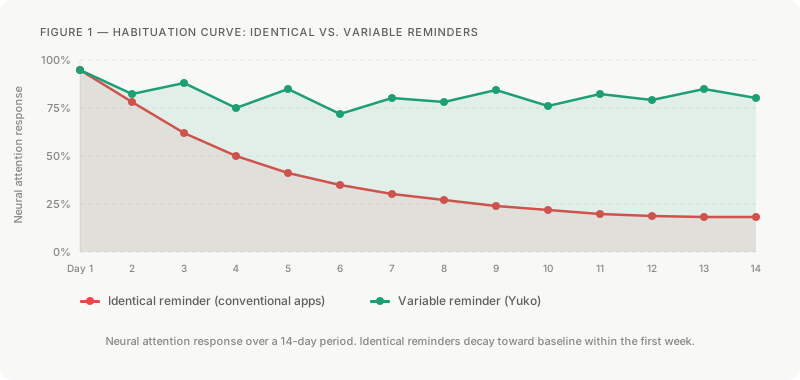
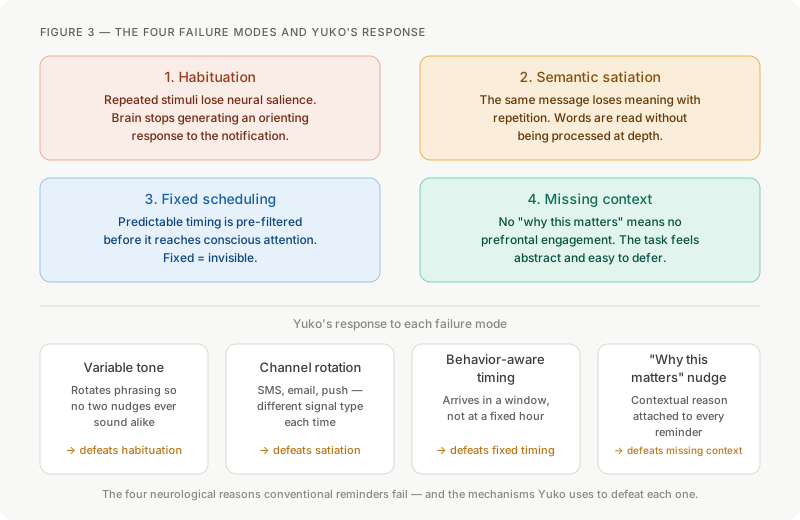
The orienting response is powerful. It’s also temporary. Present the same stimulus repeatedly, and the response diminishes. Present it enough times, and it vanishes entirely. Your brain has learned that this stimulus predicts nothing new — so it stops paying attention.
This is habituation. And it is exactly what happens to your reminders.
The problem isn’t forgetting. It’s pattern recognition.
When you set a recurring reminder — every weekday at 9am, let’s say — you’re not fighting forgetfulness. You’re creating a pattern. And the brain is extraordinarily good at recognizing patterns and then routing them around conscious attention.
By day three, your brain has already modeled that notification. It knows the icon, the vibration pattern, the approximate time it arrives, the tone of the message. That’s not a reminder anymore. That’s wallpaper.
Researchers call this stimulus-specific adaptation: the neural response to a repeated stimulus decreases over time, independent of whether you acted on it. The signal degrades not because you’re lazy or undisciplined, but because your brain is doing exactly what evolution designed it to do — conserving cognitive resources by filtering out “safe,” predictable inputs.
The cruel irony is that the more faithfully your reminder app delivers consistent, punctual, identical notifications, the faster it trains you to ignore them.
Why identical messages become invisible
There’s a secondary mechanism at work beyond pure habituation, and it lives in how your brain processes language.
When you read the same message repeatedly — “Don’t forget to follow up with Sarah” — the semantic content stops being processed at depth. Psychologists call this semantic satiation: repeated exposure to a word or phrase causes it to temporarily lose meaning, like staring at a word until it looks like nonsense.
This is why “fire drill” reminders stop working. Not because you’ve forgotten what they mean, but because your brain has learned to extract the meaning without actually engaging with it. You read “follow up with Sarah” the way you read the word “EXIT” above a door — technically processed, immediately ignored.
The implication is counterintuitive: a reminder that says exactly what you expect it to say is almost guaranteed to underperform. Novelty — in phrasing, in tone, in the angle of approach — isn’t a nice-to-have. It’s the mechanism.
The variable reward schedule: what slot machines figured out first
In the 1950s, B.F. Skinner ran a series of experiments that would eventually reshape our understanding of attention, motivation, and addiction. He gave rats levers. Sometimes pressing the lever produced food. Sometimes it didn’t.
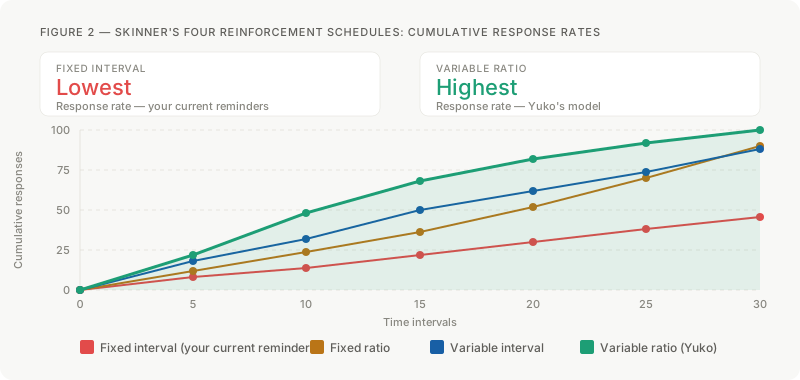
The pattern of reward delivery turned out to matter enormously. Rats rewarded on a variable ratio schedule — unpredictably, with no fixed interval — pressed their levers with compulsive persistence. Rats on fixed schedules eventually plateaued and, when rewards stopped, quit quickly.
Variable ratio schedules produce the highest response rates and the greatest resistance to extinction of any reinforcement pattern. This is why slot machines are designed the way they are. It’s why social media feeds are algorithmically randomized. Unpredictability doesn’t reduce engagement — it dramatically increases it.
The same principle applies in reverse to reminders. A fixed, predictable notification schedule is a fixed interval schedule — the least effective pattern for sustained attention and response. Your brain knows roughly when it’s coming and has already discounted it.
The “why this matters” gap
There’s a third failure mode in conventional reminders that doesn’t get talked about enough: they tell you what without telling you why.
“Review Q3 budget” is a task. It is not a reason. And behavioral research consistently shows that implementation intentions — mental links between a situation and a specific action — are far more powerful when they’re attached to meaningful context.
Psychologist Peter Gollwitzer’s research on implementation intentions found that people who formed specific “when-then” plans were significantly more likely to follow through than those who simply set goals or reminders. But there’s a further finding that often gets overlooked: the effectiveness of those plans decays when the underlying motivation isn’t present.
In plain terms: a reminder that connects the task to why it matters right now isn’t just motivationally warmer. It recruits a different cognitive pathway — one that involves the prefrontal cortex’s role in prospective memory and future-oriented decision-making, rather than just the habituated stimulus-response loop.
This is why “Don’t forget to call Mom” hits differently when it becomes “Call Mom — she mentioned she’s been anxious this week.” Same task. Completely different neural engagement.
What this means for how you set reminders
The research converges on a few clear principles:
- Variability beats consistency. Not in whether you’re reminded, but in how, when, and in what tone. Predictability is the enemy of attention.
- Phrasing should rotate. The same message loses semantic depth with each repetition. A good reminder system should never say the same thing twice in exactly the same way.
- Context amplifies action. Reminders that connect a task to its emotional or practical significance outperform purely logistical nudges.
- Timing should feel slightly unpredictable. Not chaotically — but within a window. The orienting response activates when the brain can’t fully model what’s coming.
- Channel variation matters. If every reminder comes through the same app, the same icon, the same buzz pattern, you’ve created a single habituated stimulus. Mixing delivery channels keeps the signal from being fully pre-filtered.
The deeper problem
Most reminder apps were built around a single design assumption: that the problem is forgetting. So they solve for delivery — making sure the notification arrives on time, every time, reliably.
But forgetting isn’t the core failure mode. Habituation is. And a system optimized for reliable delivery of predictable stimuli is, neurologically, a machine for generating things you’ll learn to ignore.
The irony is almost elegant: the better a conventional reminder app does its job, the faster it trains you to tune it out.
Fixing this isn’t complicated in principle. It requires acknowledging what the neuroscience actually says — that the brain’s attention system rewards novelty, variability, and meaning — and building around that, rather than around the illusion that consistency is the same thing as effectiveness.
Your brain isn’t broken when it ignores your reminders. It’s working perfectly. The question is whether your tools are working with it, or against it.
Yuko is a reminder engine built around the neuroscience of follow-through.
Variable messaging, tone rotation, and contextual nudges — designed to stay ahead of habituation.